The grid is down. The generators are guzzling fuel. And the one solution that could actually work is now to price out the very people who need it most.
Last week, we talked about solar fires. But before then, we drew attention to the trend in migration of the rich from the National Grid to solar energy at a frequency never seen before. We explained what the consequences portend for those who cannot afford the migration and who must, therefore, stay with the National grid. But in this blog post we shall explore the high cost of solar installations and why it seems to have become, almost , an exclusive reserve of the rich. Then, it may make more sense to check whether the incidence of solar fires – the terrifying reality of quack installers, counterfeit panels, and homes going up in flames is an indicator to the desire to go solar by all means necessary. Does this urgency mean avoiding critical considerations that should be made before the first solar panel is installed or that the fire is just the final symptom. But as we may learn in the following excerpts, the real crisis is deeper, more systemic, and more heartbreaking.
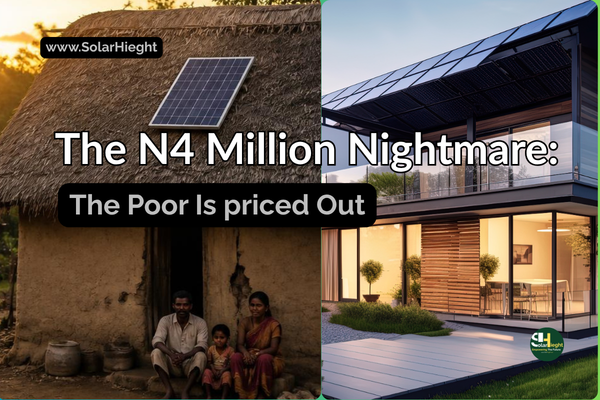
The crisis is that solar has become a luxury only the rich can afford.
A standard solar setup that cost ₦800,000 just a year ago now goes for up to ₦4 million—and sometimes more. For a country where 90 million people live without reliable electricity, where the national grid generates less than 5,000 megawatts for over 200 million citizens, this isn’t just an inconvenience. It’s a betrayal.
The Darkness We All Know
Let’s start with the problem we all know too well.
The Nigerian grid is a tragedy in slow motion. Since 1999, every president has had an “emergency power plan.” We’ve taken over $4 billion in World Bank loans for the power sector. President Obasanjo alone is claimed to have spent $16bn on Power from 1999 to 2007. Yet the grid, with installed capacity of about 13,000MW, can barely hold 5,000MW any more and it literally collapses.
The numbers are staggering:
22 million generators across the country, with a combined capacity of 42,000MW – eight times what the grid delivers
Nigeria has more generator capacity than grid capacity
In the first half of 2025 alone, manufacturers spent ₦676.6 billion on alternative power—and still couldn’t meet their needs
That translated to 18,935 jobs lost
The World Bank estimates power outages cost Nigeria $29 billion annually—about 10% of GDP
Compare this to other African nations. Egypt added 14,000 megawatts of gas capacity in six years. Ghana fixed its power crisis and now exports surplus electricity. South Africa just went 300 consecutive days without load shedding after committing to a real recovery plan.
Nigeria has been “fixing” the power problem for 25 years. We are still in the dark.
The Solar Boom—and the Price Explosion
For a moment, there was hope. Solar prices had been falling globally for a decade – dropping roughly 90% since 2014. Rooftop solar became one of the most credible electricity solutions in a country where grid power remains erratic. On this site we explored the possibility of going solar, starting with as little as 80,000 Naira. We showed a step by step approach to power freedom.
But that trajectory has reversed.
A convergence of forces is pushing solar prices higher: China’s VAT export rebate reform, rising raw material costs, and the ripple effects of global instability.
Here is what happened:
China controls more than 80% of the global solar manufacturing supply chain. For years, fierce competition among Chinese manufacturers kept prices artificially low – so low that Chinese solar companies collectively recorded net losses of about $5 billion.
Beijing’s response was structural. From 1 April 2026, China eliminated a 9% VAT export rebate on solar products entirely and reduced the rebate on batteries from 9% to 6%. That battery rebate disappears completely on 1 January 2027.
The market felt the impact immediately.
A 590W panel that sold for between N125,000 and N130,000 in January 2025 now sells for between N143,000 and N145,000
A 620W panel increased from N138,000–N145,000 to as much as N155,000
A 720W panel now sells for as much as N180,000
These increases may seem modest per panel, but multiply them across an entire installation. A typical 5kW hybrid solar system cost between N4.2 million and N5.5 million in January. By June 2026, the same installation cost had risen to N4.5 million–N5.8 million.
Nigerians who delayed installing solar by six months are now paying between N200,000 and N300,000 more. Commercial customers are feeling even greater pain – a 20kW installation now costs N300,000–N500,000 more than it did just months ago.
“I want to switch to solar, but the price is too high now. Every time I check, it has increased again,” a Lagos shop owner lamented.
The Hidden Crisis: Why Lithium Batteries Are the Main Culprit
So where does the money go? Let’s look at the numbers.
A Lagos resident, Damilola Oladipo, recently installed a solar system that cost roughly ₦5.7 million. Here’s the breakdown:
Solar panels (12 × N115,000): N1,380,000
16kWh battery: N2,700,000
8kWh inverter: N1,100,000
That battery is nearly half the total cost – and the price has only climbed since then.
Lithiumion batteries (specifically LiFePO4, the safest and most common chemistry for home solar) are the single biggest cost driver in modern solar systems. The upfront cost for a 15kWh lithium battery is about ₦2.3 million compared to about ₦900,000 for a tubular leadacid battery of equivalent nominal capacity.
A lithium battery costs about ₦230,000 – ₦320,000 per kWh.
Why are lithium batteries so expensive? They rely on materials like lithium, cobalt, and nickel – all subject to global supply chain volatility, currency fluctuations, and geopolitical instability. And the problem is that Nigeria imports virtually all of them.
The Real Question: Are Lithium Batteries Actually Worth It?
| Factor | Tubular Lead-Acid | Lithium (LiFePO₄) |
|---|---|---|
| Upfront Cost (15kWh) | ~₦900,000 | ~₦2,300,000 |
| Usable Capacity (Depth of Discharge limit) | 50% (7.5kWh usable) | 90–95% (13.5kWh+ usable) |
| Lifespan | 2–3 years | 15–20 years |
| Replacements in 10 years | 3–4× | 0× |
| 10-Year Battery Cost | ₦3.6M – ₦4.8M | ~₦2.3M (once) |
| Maintenance | Water topping, terminal cleaning | None |
| Gas Emissions | Yes (hydrogen – ventilation required) | None |
| Cost per kWh | ~₦92,000/kWh (upfront) | ~₦230,000/kWh (upfront) |
| Levelized Cost of Storage (over 15 years) | ~₦127/kWh | ~₦98/kWh |
When you spread the cost over time, lithium batteries are often the better deal. A 15kWh tubular battery bank only gives you 7.5kWh of usable energy (50% depth of discharge limit to preserve battery life). A 15kWh lithium bank gives you 13.5kWh+ usable. You effectively need nearly twice the tubular capacity to match a lithium bank.
One analysis found that while tubular batteries are cheaper upfront (₦92,000/kWh vs. ₦230,000/kWh for lithium), they incur higher operation and maintenance costs (₦46,000/kWh every 5 years) and require replacements at years 5 and 10. Over 15 years, the total cost of tubular batteries actually exceeds the cost of lithium – and lithium delivers a lower levelized cost of storage (₦98/kWh vs. ₦127/kWh for tubular).
That said, the reality is that many Nigerians simply cannot afford the upfront cost of lithium batteries – even if they had save money in the long run. A 15kWh lithium battery at ₦2.3 million is out of reach for most households, even if it lasts 15 years without replacement.
The Solar Poverty Gap
This is where we confront the true tragedy of Nigeria’s solar transition.
A 2024 academic study found that citizens could mostly afford lowcapacity solar installations, but mediumcapacity solar was found to be “quite unaffordable.” The study identified affordability as a “showstopper” in incorporating solar effectively into Nigeria’s energy mix.
In other words, the middle class is being priced out of the only reliable power source.
Lowcapacity solar (1KVA, about ₦550,000) remains somewhat affordable
Mediumcapacity solar (2.5KVA, about ₦1.9 million) is “quite unaffordable”
Highcapacity solar (5KVA, about ₦2.3 million+) is unaffordable for most Nigerians
One industry professional quoted in a BusinessDay editorial put it bluntly: “In Nigeria, however, the middle class or the poor, two demographics that should be at the forefront of this transition, are being left behind.”
What About the Government’s Celebrations?
While Nigerians struggle to afford solar, the government is celebrating.
The Rural Electrification Agency (REA) recently announced that Nigeria has attracted $425 million in investments for the establishment of eight renewable energy manufacturing facilities.
“We have moved from about 120 megawatts of local manufacturing capacity to roughly 300 megawatts today, with 3.7 gigawatts in the pipeline,” said REA Managing Director Abba Aliyu.
“For the first time, Nigeria is producing solar panels locally, and they are already being exported” from Lagos to Accra, Ghana.
On the surface, this sounds like progress. And in many ways, it is. But there’s a glaring contradiction:
While the government celebrates domestic manufacturing, solar prices continue to rise for ordinary Nigerians.
Worse, there’s a looming threat that could make things even more expensive: a proposed import ban on solar panels to protect domestic manufacturing. Industry stakeholders warn that such a ban could raise solar system prices by as much as 150% without adequate local capacity to fill the gap.
The same editorial warned: “Nigeria’s move to restrict the importation of solar panels… risks exacerbating the country’s deeprooted energy crisis… premature, poorly timed, and potentially selfdefeating.”
So What’s the Solution?
We cannot afford to wait for the grid to magically fix itself—it has been 25 years. And we can’t afford to keep paying N4 million for solar.
Here are three practical paths forward that acknowledge the reality of the moment:
1. Reconsider the Battery Choice
Given that lithium batteries cost 23 times more upfront than tubular batteries, it’s worth asking:
Could we shift back to tubular batteries for basic loads?
For households with moderate power needs- lights, fans, phone charging, small appliances—a well maintained tubular battery bank might be the most cost effective option in the short term.
The tradeoff is clear:
Tubular: Lower upfront cost, but requires maintenance (water topping, terminal cleaning), has half the usable capacity, and needs replacement every 23 years
Lithium: Higher upfront cost, but zero maintenance, deeper usable capacity, and lasts 1015 years
For someone who cannot afford N2.3 million for a lithium battery, a N900,000 tubular battery, even with its limitations, might be the only realistic path to solar power.
2. Advocate for Local Assembly to Beat the FX Crisis
Nigeria’s solar prices are tied directly to the exchange rate. As long as we import everything, prices will remain volatile and high.
The $425 million investment in local manufacturing is a genuine ray of hope. But it needs to focus not just on panel assembly, but on battery production—the single biggest cost driver.
The government should also:
Maintain low or zero tariffs on highefficiency solar imports in the short term
Offer targeted incentives (tax relief, concessional financing) for local manufacturers
Partner with global technology leaders to accelerate knowledge transfer
3. Push for Rent to Own and Financing Models
If Nigerians can’t afford the upfront cost of solar, the solution is to make it accessible through financing.
Some companies are already offering solar on a “payasyougo” basis. These models need to scale rapidly, with government backing and consumer protection.
The Bottom Line
The Nigerian solar crisis is a crisis of affordability.
The grid is broken. Generators are too expensive to run. Solar is the only answer – but it’s becoming a luxury only the rich can afford.
This is not just an energy problem. It’s a poverty problem. A justice problem. A problem that is pushing the middle class back into darkness while the rich power their homes and businesses on clean energy.
We need a national conversation about how to make solar accessible to everyone, not just those who can afford to spend N4 million.
What’s at stake?
The 90 million Nigerians without reliable electricity
The small businesses that can’t afford to scale because of power costs
The families who spend half their income on fuel for generators
This is not just an inconvenience. It is a barrier to economic opportunity, education, and human dignity.
A Call to Action
This post has been a followup to our exploration of solar fires and The Great Defection. But it’s also part of a larger series on why Nigeria’s energy transition is failing the very people it should help.
In the coming weeks, we’ll explore:
The Generator Economy: Why the $16 billion generator industry is a lie that’s holding us back
Beyond the Village Light: What real rural electrification would actually look like
For now, here is my question to you:
If you have solar- or are thinking about it – what’s your experience with the cost? Have you been priced out? Have you found a solution that works?
Share your story in the comments or reach out directly. We need to start talking honestly about the choices Nigerians are forced to make.