The Nigerian dream of escaping the national grid has a dark side – and it is spreading faster than a Harmattan fire.
This post was burn out of a very important question asked by one of our followers on social media. And that question is at the heart of a dangerous development in the Nigeria Solar experience that needs urgent attention.
Agreed! You have finally done it. You have invested millions of Naira in a solar system. No more fuel queues. No more generator fumes. No more “NEPA has taken light” anxiety.
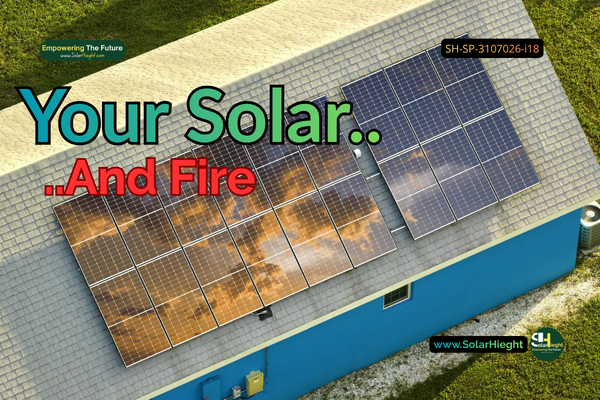
But here is the question that probably did not cross the minds of many in this thrashed but it is recurring in small places and it it gradually attracting a lot of concerns: Could your solar panels burn your house down?
It is not fear-mongering – It is happening right now, across Nigeria. The Nigerian Electricity Management Services Agency (NEMSA) has officially raised the alarm over an increasing number of fire incidents linked to improperly installed rooftop solar systems .
The solar boom in Nigeria has been phenomenal. Persistent blackouts, surging diesel prices, and a grid that chronically falls short have turned solar into one of the fastest-growing segments of Nigeria’s energy economy . But this boom has a dangerous downside: installations are outpacing oversight .
“What we are seeing is a market that has grown faster than the systems meant to govern it,” said Chidi Okafor, a Lagos-based electrical engineer with over two decades of experience. “People are desperate for power. That desperation is being exploited by installers who are not qualified and suppliers who are moving substandard products.”
This post will show you exactly why these fires happen, how to spot the warning signs, and how to protect your investment – and your family.
Real Incidents: This Is Not “Theoretical”
Benin City: Anambra Supermarket Goes Up in Flames
In June 2026, a popular supermarket in Ikpoba Hill area of Benin City was engulfed by fire. The incident, which destroyed goods worth millions of Naira, was suspected to have originated from a fault in one of the solar panels installed on the roof of the two-storey building .
An eyewitness, Blessing Aidengbe, told reporters, “I suspect there was a faulty panel among those installed on the roof because such faults can trigger a fire outbreak” . The prompt intervention of firefighters prevented the entire building from being consumed- but the damage was already catastrophic .
Ogbomoso: Overloaded Solar Installation Engulfs a Home
On the same week in June 2026, the Oyo State Fire Services Agency responded to a distress call at Aaje Ologo area of Ogbomoso. A private three-bedroom flat had been completely engulfed by flames and thick smoke. The cause? An overloaded solar power installation mounted on the roof .
Preliminary investigation revealed that the system was simply not designed to handle the load it was carrying. No casualties were recorded, but properties worth millions of Naira were destroyed .
The Special Adviser on Fire Services Reform, Hon. Dr. Moroof Adebayo Akinwande, issued a stark warning: “Solar power systems must be installed only by qualified and certified technicians all components must meet approved safety standards and be properly sized to avoid overloading” .
Why Do Solar Fires Happen? The Science Behind the Smoke
Solar panels themselves are seldom the direct ignition source . According to engineers, the greater risks lie “downstream”- in what connects the panel to your home .
The Science in Plain Language
Heat is a thief and an arsonist. During peak solar radiation, the current flowing through your system’s wires is at its maximum . If the wires are undersized (a common Nigerian shortcut), they heat up due to electrical resistance. “As the electrons flow, they face resistance within that wire and they will heat up to the extent that some of them can even melt. If the two spark, it can ignite fire,” warned Prof. Idris Bugaje, Executive Secretary of NBTE .
Arcing is the silent killer. Loose connections, damaged cables, or faulty junction boxes can cause electrical arcs—sparks that can reach temperatures hot enough to melt metal .
Hot spots on panels are ticking time bombs. Damaged or shaded panels can develop “hot spots” where a single cell overheats dramatically. This can lead to fires that spread from the panel itself .
NEMSA’S FINDINGS
The Root Causes (according to NEMSA- Nigerian Electricity Management Services Agency and Experts) are primarily captured in NEMSA’s investigations of these fire incidents :
1. Poor workmanship – “Quack” installers who have no training or certification .
2. Substandard materials – Fake cables, counterfeit breakers, and damaged panels .
3. Absence of protective devices – No circuit breakers, surge protectors, or proper earthing .
4. Non-compliance with technical standards – Ignoring every rule in the book to save time and money .
Adaeze Nwosu, a renewable energy consultant based in Enugu, told BusinessDay: “I have visited homes where the cables used were not rated for the current passing through them. It is only a matter of time before something goes wrong. The panel on the roof looks fine. The danger is hidden inside the walls. ”
The Perfect Storm: Why Nigeria Is Particularly Vulnerable
1. Desperation Drives Bad Decisions
People are desperate for power. That desperation is being “exploited by installers who are not qualified and suppliers who are moving substandard products” . When someone offers you a solar system at half the market price, it’s tempting. But as Emeka Eze, technical director at a renewable energy firm in Abuja, warned: “A lithium battery that is poorly managed is not a power source—it is a fire hazard. Manufacturers’ specifications exist for a reason. When people ignore them to save money, they are transferring risk directly to their household” .
2. No Regulatory Teeth (Yet)
A 2025 academic study on solar fire hazards in Nigeria concluded that “there are no accredited or approved vendors for solar panel installations and no specific legal framework for solar energy utilisation in Nigeria. Furthermore, there is no insurance coverage for both lives and properties in the event of fire accidents resulting from solar panels” .
The Federal Government is now responding. Under the Electricity Act 2023, NEMSA has issued comprehensive safety guidelines- but they need enforcement .
3. Rooftop Installations Are the Norm – And They’re Dangerous
Prof. Idris Bugaje also warned that the standard practice of mounting solar panels on rooftops is itself a risk: “The installations that are going on across the country on rooftops are very unprofessional and they are risks to fire” . He also noted that most roofs are sloped at 60-70 degrees, which is not ideal for solar collection and can exacerbate overheating issues .
NEMSA’s New Safety Guidelines: What You MUST Demand
NEMSA has now issued mandatory safety guidelines under the Electricity Act 2023 . Any installer who ignores these is putting your life at risk. Demand these from your contractor:
Why It Matters NEMSA-certified installer:
The following are why it matters to have a NEMSA- certified installer. Installers must be the ones that posses the necessary skills, experience, and knowledge of technical standards .
There has to be a proper load assessment and the system must be sized for your actual needs—not “copied from your neighbour. Inclusive in that is also a structural assessment to ensure that the roof must be structurally sound enough to support the system. A minimum 0.13m ventilation clearance prevents overheating of panels during high temperatures .
It is critical to have DC and AC isolators installed to enable emergency shutdown in case of a fault. Circuit breakers and surge protectors must be in place to prevent overloading against lightning surges. Proper earthing (≤2 ohms resistance) is a must to prevent electrical shock and reduce fire risk. Batteries must be insttalled in ventilated, secure locations away from living areas and heat sources. Lithium batteries with good Battery Management System and cooling is very essential for safe operation. When there is no well structured BMS, the possibility of fire becomes indirectly calculated to the equation. Regular maintenance must include a well structured plan of cleaning, cable inspection, and timely component replacement .
Your 5-Point Safety Checklist
Before you install – or if you already have a system – use this checklist to assess your risk:
1. Did a Certified Installer Do the Work?
– Red Flag: The installer couldn’t show a valid NEMSA certificate.
– Action: Demand proof. If they can’t produce it, walk away. NEMSA now partners with REAN to train and certify installers—use only those professionals .
2. Are Your Cables Properly Rated?
– Red Flag: The cables feel hot to the touch on a sunny afternoon.
– Action: Check that cables are rated for the maximum current your system can produce.
3. Is There Proper Ventilation Around Your Panels and Batteries?
– Red Flag: Panels are flush against the roof with no gap. Batteries are in a cupboard.
– Action: Ensure at least 0.13m gap for panels and a dedicated, well-ventilated area for batteries .
4. Do You Have the Right Protective Devices?
– Red Flag: You don’t have DC isolators, circuit breakers, or a surge protector.
– Action: These are non-negotiable. If they’re missing, get them installed immediately.
5. Are You Doing Regular Maintenance?
– Red Flag: You haven’t cleaned or inspected your system in months.
– Action: Schedule a quarterly check-up. NEMSA advises: “Clean panels to prevent dust accumulation and overheating. Inspect cables, connectors, and the inverter. Promptly replace damaged components.”
The Bottom Line
The Nigerian solar boom is a blessing- but only if done right. As an engineer put it, “The issue is not solar energy itself, but the quality of installation” . Poor wiring, improper battery placement, and inadequate ventilation can turn your path to energy independence into a path to disaster.
Don’t let desperation make you a victim. Solar systems are investments that should last 25 years- not 25 months. Invest in quality. Invest in certified installers. Invest in your family’s safety.
Over to You
Have you experienced a solar installation scare? Have you ever wondered if your system is safe? Drop a comment below or reach out to us – we are here to help you navigate the solar revolution safely.
P.S. If you are in doubt about your current system, please consult a professional. Don’t wait for the smoke to tell you something’s wrong.