An educational guide to choosing between Monocrystalline and Polycrystalline solar panels, with your wallet and sanity in mind.
If you live in Nigeria and you are reading this, you already know the struggle. You have probably spent more hours in the dark than you have watching your favourite Nollywood movies. You have poured money into generators that guzzle fuel like a thirsty camel, and you are tired of the noise, the fumes, and the anxiety of “will it start today?”
Solar power sounds like the promised solution. But when you start looking, you are faced with a decision: Monocrystalline or Polycrystalline? These are the two types of Solar Panels.
This is not just a technical jargon test. Choosing wrong can mean the difference between powering your home for 25 years and having an expensive, underperforming slab of glass on your roof within a few years.
This guide cuts through the noise to help you make the right choice for the Nigerian condition.
The Two Main Contenders
Before we dive in, make sure you’ve read our complete guide on sizing your system correctly—click here
Let’s break down the two dominant types of solar panels available in the market.
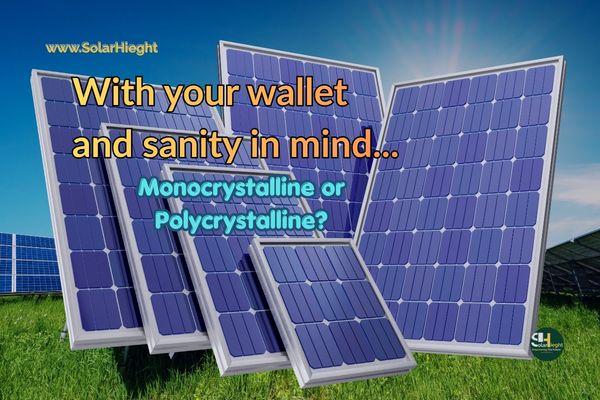
Monocrystalline Panels: The High-Performer
Think of these as the “top shelf” option. They are made from a single, pure silicon crystal, giving them a sleek, uniform black appearance .
- – Efficiency: They are the most efficient, converting 15% to 23% of sunlight into electricity
- Lifespan: They have a long lifespan, often exceeding 25 years.
- Cost: They are generally the more expensive option.
Nigerian Reality Check: Because they produce more power per square metre, monocrystalline panels are ideal if you have limited rooftop space (common in Lagos and other urban areas) but need to generate significant electricity. A study at Ago-Iwoye found that actual weather conditions can reduce panel output significantly compared to manufacturers’ claims . With monocrystalline, you have a better chance of meeting your needs despite these losses.
Polycrystalline Panels: The Budget-Friendly Workhorse
These are made by melting multiple silicon fragments together. They are easily recognised by their speckled blue colour.
- – Efficiency: They are less efficient, typically ranging from 13% to 18% .
- – Lifespan: They have a slightly shorter lifespan of 20-25 years .
- – Cost: They are more affordable, making them a popular choice for budget-conscious buyers.
Nigerian Reality Check
A study in Nigeria showed that the surface temperature of a polycrystalline panel could be reduced from 49.25°C to 38.38°C with cooling, which increased its efficiency from 13.99% to 15.01% . This is crucial because Nigerian heat is a major efficiency killer.
The Nigerian Factor
Why “Simple” Buying Doesn’t Work
The choice isn’t just about specs. It’s about surviving the Nigerian environment. Here’s what you need to consider:
1. The Heat is a Thief
Before we dive in, make sure you have read a complete guide on sizing your system correctly—click here.
Nigeria’s abundant sunlight is a blessing and a curse. The high solar radiation increases the surface temperature of PV panels well above the optimal 25°C, which reduces their efficiency . This is why a panel that promises 400W might only deliver much less under the scorching sun. Monocrystalline panels often handle heat slightly better than polycrystalline, but both will see a drop in performance .
2. The Rainy Season “Surprise“
The rainy season is a nightmare for unprepared solar owners. Experts at SolarNaija note that during the rainy season, a “haze” of mineral deposits and dust can cut energy output by between 15 and 30 percent . Rain doesn’t clean your panels; it leaves a film that blocks sunlight. Regardless of whether you choose mono or poly, you must commit to cleaning them with a soft cloth and water every few weeks during this period .
3. The “One-Size-Fits-None” Approach
A solar expert, Yakubu Yunusa, highlighted a common mistake: “Many Nigerians simply copy a neighbour’s solar setup without professional audits, leading to undersized or oversized systems” . He recounted a client who spent ₦1.5 million on a 1KVA off-grid system that drained within hours because it wasn’t designed for their actual appliance load .
4. The Cost Barrier and the “Substandard” Trap
Solar is expensive. Music producer Somik Chris Ikesom told DW that while solar transformed his studio, “Installing solar these days is not cheap. It runs into millions” . This high cost leads many to seek out cheaper options, which is where the danger lies. [Internal Link to how to grow your solar]The market is flooded with cheap, uncertified batteries and panels that fail within months . This is a huge reason why many solar systems fail, not because the technology is bad, but because of “poor planning, the use of substandard materials, and unqualified workmanship” .
5. Safety and “Quack” Installers
The desperate rush for solar has created a dangerous situation where installations are outpacing oversight . The Nigerian Electricity Management Services Agency has raised concerns about fire incidents linked to improperly installed solar systems . The panels themselves are rarely the cause; the danger is in “undersized wiring, poorly connected electrical systems, defective charge controllers, and batteries installed without adequate ventilation” . A cheap polycrystalline panel from a reputable brand is a far better investment than a “bargain” monocrystalline panel installed by a quack.
The Verdict: Which One Should You Buy?
Choose Monocrystalline If:
- 1. You have limited rooftop space in a city like Lagos or Abuja.
- 2. You are willing to pay a premium for maximum power generation.
- 3. You have the budget to buy high-quality panels from a Tier 1 manufacturer . There are no Tier 1 Nigerian panel manufacturers yet, so you will be buying imported . The government is considering a ban on imports to boost local manufacturing, but for now, careful sourcing is key .
Check current prices for authentic Monocrystalline panels here or View top-rated Polycrystalline options on Jumia.
Choose polycrystalline If:
- 1. You have ample space for installation (e.g., a large compound in the suburbs).
- 2. You are on a tighter budget and need a cost-effective solution.
- 3. You plan to use a proper cooling mechanism (like a hybrid PV-thermal collector) to boost efficiency, which a study has shown can work well with polycrystalline panels in Nigeria .
Beyond the Panel Type: Your Success Checklist
Before you spend a single kobo, do this:
At the very end, after the final “Do it right” sentence.
Don’t leave your solar future to chance. Check steps to build the solar system of your dream
- 1. Get a Professional Power Audit: Do not copy your neighbour’s setup! A qualified installer will calculate your exact energy needs. As Yunusa advises, “The problem has never been that solar technology doesn’t work. The real issues are poor planning” .
- 2. Buy Quality, Not Price: “Choosing price over quality” is one of the top five errors causing solar failures . Look for international certifications like IEC 61730 for safety and IEC 61701 for durability . A cheap panel will cost you more in the long run.
- 3. Hire Certified Installers: If you have to ask “how much to install?” you’re not ready. Ask “are you certified?” “Using unqualified installers and DIY shortcuts” is a recipe for disaster .
- 4. Maintain Your System: Neglecting maintenance is a guaranteed way to fail. Make sure you get a system that has readily available after-sales support, and clean your panels regularly, especially during the rainy season .
Read our full guide for Nigerian homes here.
In short: For a Nigerian user, the monocrystalline vs. polycrystalline debate is secondary to the primary rule: Do your research, hire a pro, and never sacrifice quality for a lower price. Your solar system is a long-term investment in peace of mind. Do it right, and you’ll be laughing all the way to the bank while your neighbours are still buying fuel.