Skip to content
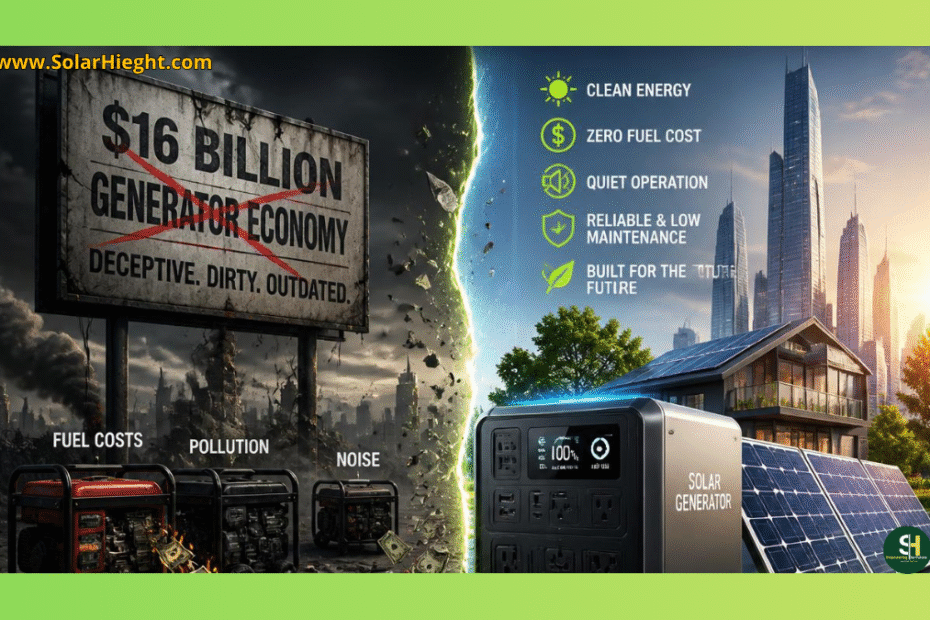
Two scenarios are presented: one depicting an economy reliant on generators and the other a promise of renewable energy. This post uses both to illustrate the waste people are forced to endure following power outages and the subsequent reliance on generators to power various sectors of the economy. The situation in Nigeria is not improving and the solution as evidence show in this blog, is solar energy.

The Generator Economy is a $16 Billion Lie: Why 2026 is the Year of the Solar Generator

Why do people still patronise generators despite the data that shows that it is not cheap in the long run? Does the Nigerian government really appreciate the enormous fund that is wasted in the generator economy? Could it not make sense to block this hole and find ways to redirect these wastages elsewhere? Who is benefitting from increased investment in this economy? Is the generator economy the reason our National Grid is still in shamble?

A few years ago, the promise of solar in Nigeria brought formidable changes in the Nigeria energy architecture. It started in small places and small things. With our touches, fans , a few bulbs, charging pots etc. Then it progressed to powering homes, businesses etc. Within a short time, Nigerian business ingenuity found ways to crash the prices. Solar became affordable for people and in places that had suffered untold energy hardship. That promise resonated and consequently Solar became a thriving economy.

But recently, that dream seems to be fading with the high rise in solar materials. While the rise in prices could be explained by enormous upfront costs of solar materials, changes in solar manufacturing subsidies and foreign exchange volatility, it has also seen a retreat by people back to generators thereby providing sustenance to that economy. But that believe that generator economy entry point is cheap is a story that we have been sold. And it’s costing us everything.

Last three weeks, we explored why solar has become a luxury only the rich can afford- how a system that cost ₦800,000 just a year ago now goes for up to ₦4 million, pricing out the very people who need it most.

It seems to support the age-long investment in generators still as a credible cheaper source of power generation. But here’s the uncomfortable truth we must confront: Generator is also not cheaper. It looks so at a face glance but it is not. We have actually been pouring billions into generators, without noticing it as we did with solar and the real issue is that we have been paying for a lie.

The generator economy in Nigeria is not a solution. It is a trap. A $16 billion annual trap that is draining our economy, killing our people, and keeping us in darkness while we pretend we are “managing.”

The Numbers that Should Shock You

Let’s start with the scale of this crisis.

The International Monetary Fund (IMF) estimates that Nigerians spend $14 billion annually on petrol for generators alone – surpassing the nation’s entire education and health budgets combined.

But that’s just the beginning.

A comprehensive analysis by economist Martins Itua, Director of Arthur Group, paints an even more staggering picture. According to his projections, if five million households and small enterprises consume a conservative average of four litres of petrol daily, the collective fuel bill surpasses ₦26 billion each day.

When factoring in heavy industrial diesel used by banks, supermarkets, and manufacturing plants, the national daily fuel bill for self-generation approaches ₦60 billion.

That translates to roughly ₦1.8 trillion every month and nearly ₦22 trillion annually.

 How Big Is This Shadow Economy?

The scale of Nigeria’s generator dependence is without parallel among major economies.

The country of more than 220 million people generates, on average, only a fraction of the electricity its population and industries require. The national grid, with an installed capacity of over 12,000 megawatts, consistently generates less than 5,000MW – woefully inadequate for a nation of this size.

The International Finance Corporation (IFC) reports that Nigeria is among the top six countries globally – alongside India, Iraq, Pakistan, Venezuela, and Bangladesh – with the highest backup generator usage. The IFC estimates Nigeria’s installed generator capacity at 15-20 gigawatts, compared to just 5-15 GW from the grid.

A study by Dalberg found that the collective capacity of small petrol generators in Nigeria is eight times the capacity of the national grid. The firm estimates that around 22 million households and businesses rely on such units, with annual spending on acquisition and fuel reaching $12 billion.

That is the generator economy – a shadow power system more than eight times larger than the official grid.

 The Human Cost: Businesses Drowning in Fuel Bills

The statistics are one thing. The human cost is something else entirely.

Mama Nkechi, a restaurant owner in Surulere, Lagos, represents millions of small entrepreneurs trapped in this system. She told BusinessDay:

If I don’t use my generator, my food will spoil, and customers will leave. But fuel costs are eating up my profits. Sometimes I spend more on petrol than ingredients“.

A survey by the Nigerian Tribune reveals that most businesses are struggling, making little profit, trying to stay afloat due to the high cost of operations fuelled by alternative power sources. Businesses like cafe outlets are folding up due to the non-availability of electricity and the high cost of fuelling generators.

The numbers are devastating:

– Operating a 100kVA generator typically costs over ₦1 million monthly

– A typical business with a 100kVA generator can spend over ₦1,071,250 monthly on fuel and maintenance

– Running a small 5kVA generator for 6 hours daily costs roughly ₦4,000–₦8,000 for fuel

– Some small businesses spend up to 40% of their income on energy generation

This is not a solution. This is a tax on survival.

 The Economic Black Hole

According to Sustainable Energy for All (SEforALL), in partnership with the Lagos State Government, Lagos residents alone spend $10 billion annually on fuel and generator maintenance.

But the costs go far beyond fuel bills.

The African Development Bank’s African Economic Outlook 2026 report found that power outages are costing Nigerian businesses an estimated 3% of their annual sales, forcing firms to spend heavily on alternative power sources.

According to the report, 70.7% of Nigerian firms own or share generators, highlighting the extent to which businesses have turned to self-generation to cope with electricity shortages. Nigeria recorded one of the highest levels of generator dependence among the countries referenced in the report, ahead of South Africa (63.3%) and Tanzania (38.7%).

Electricity outages account for losses equivalent to three per cent of annual sales in Nigeria.

When factoring in wider systemic issues – including disrupted production lines, damaged equipment, and spoiled agricultural goods – the broader economic cost of unreliable power exceeds ₦48 trillion annually.

At current exchange rates, this represents a yearly loss of over $35 billion. With the federal budget standing at approximately ₦55 trillion, the nation is losing an amount nearly equivalent to its entire federal spending package every single year.

 The Health and Environmental Catastrophe

The economic cost of Nigeria’s energy crisis is only part of the story. The health and environmental consequences are equally dire.

The World Health Organisation (WHO) estimates that generator emissions are responsible for more than 20,000 premature deaths annually, largely due to respiratory complications.

The noise pollution is another issue. In many cities across Africa’s largest oil producer, one sound is inescapable: the incessant hum of generators. From the high-rises of Victoria Island to the congested stalls of Alaba market or that of Ariaria Market, nearly every home and business in Nigeria depends on generators to keep the power flowing.

A 2025 academic study analyzing the comparative cost- benefit analysis of solar versus generators in Lagos found that the pollution-related economic costs that the average Nigerian household incurs due to a lack of stable electrical power are immense. The study highlights the “lack of affordability and accessibility” to more economically and environmentally sustainable alternatives for backup power.

We are burning money to poison ourselves. And we call it “managing.”

 The Structural Failure Behind the Numbers

So why do we continue this insanity?

According to Chidi Okonkwo, an energy analyst at Lagos-based Frontier Economics:

“This is not just a fuel story. This is a story about the structural failure of the Nigerian state to deliver basic infrastructure, and what that failure costs in real money, every single day”.

Economists have long argued that the failure to secure reliable grid electricity has exacted an incalculable socio-economic toll over more than three decades. The cost is not merely financial but structural, eroding Nigeria’s competitiveness, deterring foreign investment, and projecting to the outside world an image of a country unable to guarantee its own most basic productive inputs.

Since 2010, Nigeria has recorded at least 222 partial and total grid collapses. Generation crashed from 3,825 megawatts to 39 megawatts in minutes—a country of over 200 million people, plunged into darkness, again.

Meanwhile, more than six in ten manufacturing firms have abandoned the national grid entirely. Manufacturers now spend over ₦45 trillion a year on diesel, petrol, and captive generators just to keep their factories running.

The result? Nearly 19,000 manufacturing jobs lost in the first half of 2025 alone. An estimated ₦10.1 trillion lost every single year to a power sector that cannot deliver power.

The Diesel Crisis Worsens

The situation has only deteriorated further.

Surging diesel prices are threatening to choke Nigeria’s vast generator economy. The price of diesel has climbed to as high as N1,650 per litre in parts of the country.

The reasons include:

– Conflict in the Middle East tightening supplies of both industrial fuel and the grades of crude oil best suited to produce it

– Ukrainian drone strikes on Russian refineries and Western sanctions on Moscow’s energy exports

– The naira’s depreciation following the removal of the currency’s longstanding peg, meaning internationally priced commodities like diesel now arrive at a far more punishing exchange rate

Small and medium-sized enterprises, which form the backbone of Nigeria’s non-oil economy, are among the hardest hit. Manufacturers report that energy costs, already accounting for a disproportionate share of their operating expenses, are squeezing margins to the point where production cutbacks are becoming unavoidable.

“Every time diesel goes up, something has to give,” said the owner of a printing business in Lagos’s industrial suburb of Isolo. “Either we raise prices, we cut staff, or we shut a shift. There is no fourth option”.

 Why Not Just Switch to Solar?

This is where we return to the theme of our previous post.

A Nigerian Tribune investigation found that solar installation is very expensive, with one business owner spending close to N5 million to install solar in his shop. Many businesses cannot afford this upfront cost, even though solar would save them money in the long run.

A 2024 academic study identified that citizens could mostly afford low-capacity solar installations, but medium-capacity solar was found to be “quite unaffordable”. The study identified affordability as a “showstopper” in incorporating solar effectively into Nigeria’s energy mix.

This is the cruel irony: the only solution that works long-term is out of reach for the people who need it most.

The Parallel Economy: A System That Rewards Failure

What we have created is a system that rewards the failure of the grid.

A LinkedIn analysis of Nigeria’s “Dual Energy System” describes this dynamic perfectly:

“Nigeria’s challenge is not a lack of solutions. It is a system-wide trust deficit across: Power (Generators vs Solar) and Mobility (ICE vs EVs). In both cases, the market defaults to: What works consistently today, not what promises efficiency tomorrow”.

The analysis continues:

“Nigeria is not resisting transition. It is managing risk. Generators and petrol vehicles represent certainty and control. Renewable energy and electric mobility represent efficiency and the future. The shift will happen when the ‘future’ becomes: Reliable, Accessible, Commercially trusted at scale. Until then, both systems will continue to run in parallel”.

This is the lie: that generators represent “certainty.”

They represent certainty only in their cost. Certainty in their pollution. Certainty in their noise. Certainty in their ever-increasing burden on the Nigerian family and business.

 A Glimmer of Hope: The Quiet Transition

Despite everything, change is happening – not because of government policy, but because simple economics is forcing it.

Across Nigeria’s roughly 14,000 licensed filling stations, a quiet but accelerating transition is underway. Operators who spent decades treating diesel generators as an unavoidable cost of doing business are now choosing solar and battery storage instead.

The trigger was the fuel subsidy removal of May 2023. A litre of diesel that cost N750 in early 2023 was trading above N1,600 by the middle of 2024. For a large station running two generators around the clock, the monthly fuel bill could easily exceed N3 million.

At the same time, the landed cost of solar panels in Nigeria has fallen sharply. Chinese manufacturers, facing overcapacity at home and tariff pressure in Western markets, have redirected exports to Africa. Industry figures suggest the cost of a commercial rooftop solar installation fell by roughly 35 percent in naira terms between 2022 and 2025, even accounting for currency depreciation.

The numbers now work:

A mid-sized station consuming roughly 200 kilowatt-hours per day might spend between N35 million and N55 million on a solar-plus-storage system. At current diesel prices, the same station was spending N80 million or more per year on generator fuel. Payback periods of 18 to 30 months are now routinely cited by installers

The Petroleum Products Retail Outlets Owners Association of Nigeria estimates that fewer than 12% of the country’s stations have so far made a full or partial switch to solar – but that share has nearly tripled since 2023, and association officials expect it to double again within two years.

 The Path Forward: Ending the Lie
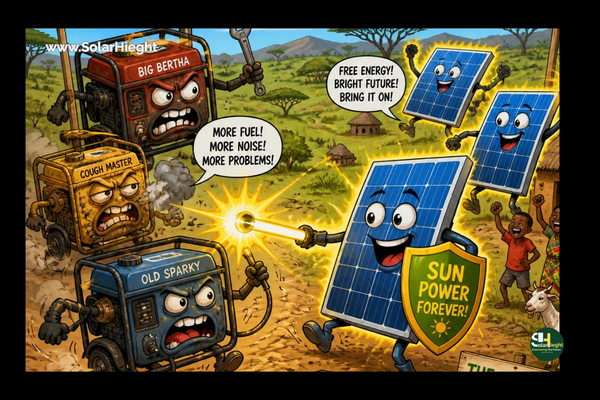
a comical image of a seemingly struggle between clean energy and fossil fuel as depicted here by generators sets and solar panels.

The “Generator Economy” in Nigeria is a $16 billion lie because it pretends to be a solution when it is, in fact, a symptom of failure. We have been sold the idea that generators are “managing.”

But managing has cost us:

– ₦22 trillion annually in fuel alone

– 20,000 premature deaths from generator emissions

– 70% of businesses dependent on self-generation

– 3% of annual sales lost to outages

– 19,000 manufacturing jobs lost in six months

The lie is this: that we can’t afford to fix the grid.

The truth is that we can’t afford not to. We are already paying – in fuel bills, in lost productivity, in dead citizens, in a nation that cannot industrialise.

As economist Martins Itua puts it:

“A nation cannot industrialise in darkness. A country cannot become globally competitive when millions of its citizens spend productive hours solving an infrastructure problem that should have been resolved by the state”.

He estimates that upgrading the national electricity supply to a stable 25,000 megawatts within four years would unlock massive latent growth across manufacturing, digital services, and agricultural processing, creating a viable path to double the size of the Nigerian economy from $400 billion to $800 billion within a single presidential term.

The “Generator Economy” is not an economy. It is a tax on our collective future.

This post has been a follow-up to “The N4 Million Nightmare” and our exploration of why solar has become a luxury only the rich can afford. But it’s also part of a larger series on why Nigeria’s energy transition is failing the very people it should help.

We need to have an honest conversation about the generator economy – not as a solution, but as the failure it truly is.

Questions for reflection:

1. How much do you spend on fuel for your generator every week? Every month? Every year?

2. What would you do with that money if you didn’t have to spend it on fuel?

3. How many businesses in your community have closed because they couldn’t afford the cost of self-generation?

4. What would it take for you to finally break free from the generator trap?

Share your story. Your experience matters. Because the generator economy is not just a statistic – it is a daily reality for millions of Nigerians. And the only way to change it is to name it for what it truly is: a $16 billion lie.

Advice for Users: Stop buying oversized inverters you don’t need. Datadriven, modular solar generators are cheaper, scalable, and offer a better ROI than maintaining a noisy, fumeemitting petrol generator.
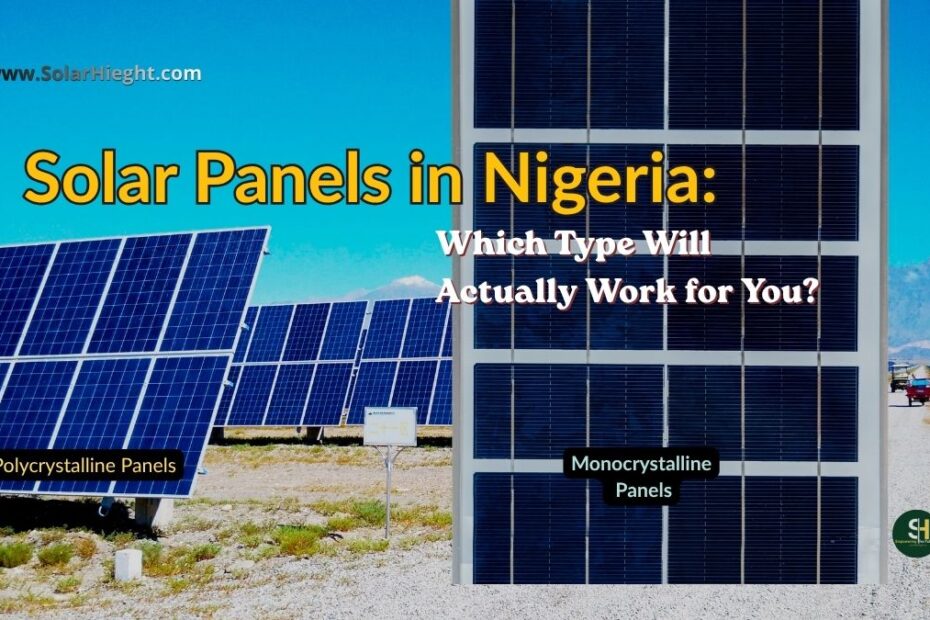
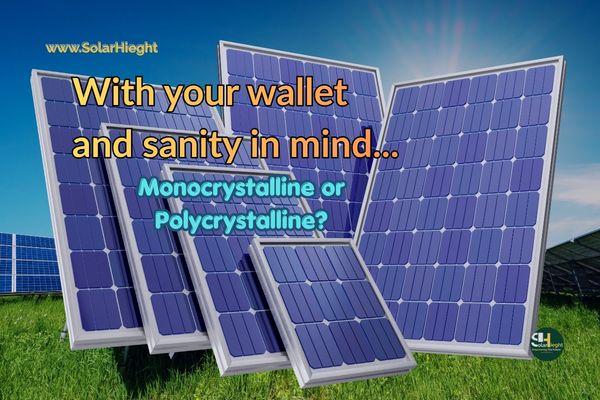
An image of two types of solar panels in Nigeria

 Solar Panels in Nigeria: Which Type Will Actually Work for You?

An educational guide to choosing between Monocrystalline and Polycrystalline solar panels, with your wallet and sanity in mind.

If you live in Nigeria and you are reading this, you already know the struggle. You have probably spent more hours in the dark than you have watching your favourite Nollywood movies. You have poured money into generators that guzzle fuel like a thirsty camel, and you are tired of the noise, the fumes, and the anxiety of “will it start today?”

Solar power sounds like the promised solution. But when you start looking, you are faced with a decision: Monocrystalline or Polycrystalline? These are the two types of Solar Panels.

This is not just a technical jargon test. Choosing wrong can mean the difference between powering your home for 25 years and having an expensive, underperforming slab of glass on your roof within a few years.

This guide cuts through the noise to help you make the right choice for the Nigerian condition.

 The Two Main Contenders

Before we dive in, make sure you’ve read our complete guide on sizing your system correctly—click here

Let’s break down the two dominant types of solar panels available in the market.

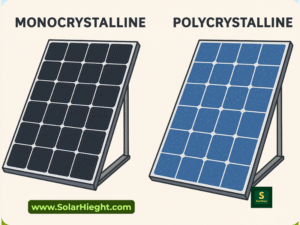
An image of solar panels on display indicating the existence of different panels and the choice Nigerians have in the face of these two main types.

Monocrystalline Panels: The High-Performer

Think of these as the “top shelf” option. They are made from a single, pure silicon crystal, giving them a sleek, uniform black appearance .

  • – Efficiency: They are the most efficient, converting 15% to 23% of sunlight into electricity
  • Lifespan: They have a long lifespan, often exceeding 25 years.
  • Cost: They are generally the more expensive option.

Nigerian Reality Check: Because they produce more power per square metre, monocrystalline panels are ideal if you have limited rooftop space (common in Lagos and other urban areas) but need to generate significant electricity. A study at Ago-Iwoye found that actual weather conditions can reduce panel output significantly compared to manufacturers’ claims . With monocrystalline, you have a better chance of meeting your needs despite these losses.

 Polycrystalline Panels: The Budget-Friendly Workhorse

These are made by melting multiple silicon fragments together. They are easily recognised by their speckled blue colour.

  • – Efficiency: They are less efficient, typically ranging from 13% to 18% .
  • – Lifespan: They have a slightly shorter lifespan of 20-25 years .
  • – Cost: They are more affordable, making them a popular choice for budget-conscious buyers.

Nigerian Reality Check

A study in Nigeria showed that the surface temperature of a polycrystalline panel could be reduced from 49.25°C to 38.38°C with cooling, which increased its efficiency from 13.99% to 15.01% . This is crucial because Nigerian heat is a major efficiency killer.

 The Nigerian Factor

Why “Simple” Buying Doesn’t Work

The choice isn’t just about specs. It’s about surviving the Nigerian environment. Here’s what you need to consider:

 1. The Heat is a Thief

Nigeria’s abundant sunlight is a blessing and a curse. The high solar radiation increases the surface temperature of PV panels well above the optimal 25°C, which reduces their efficiency . This is why a panel that promises 400W might only deliver much less under the scorching sun. Monocrystalline panels often handle heat slightly better than polycrystalline, but both will see a drop in performance .

 2. The Rainy Season “Surprise

The rainy season is a nightmare for unprepared solar owners. Experts at SolarNaija note that during the rainy season, a “haze” of mineral deposits and dust can cut energy output by between 15 and 30 percent . Rain doesn’t clean your panels; it leaves a film that blocks sunlight. Regardless of whether you choose mono or poly, you must commit to cleaning them with a soft cloth and water every few weeks during this period .

 3. The “One-Size-Fits-None” Approach

A solar expert, Yakubu Yunusa, highlighted a common mistake: “Many Nigerians simply copy a neighbour’s solar setup without professional audits, leading to undersized or oversized systems” . He recounted a client who spent ₦1.5 million on a 1KVA off-grid system that drained within hours because it wasn’t designed for their actual appliance load .

 4. The Cost Barrier and the “Substandard” Trap

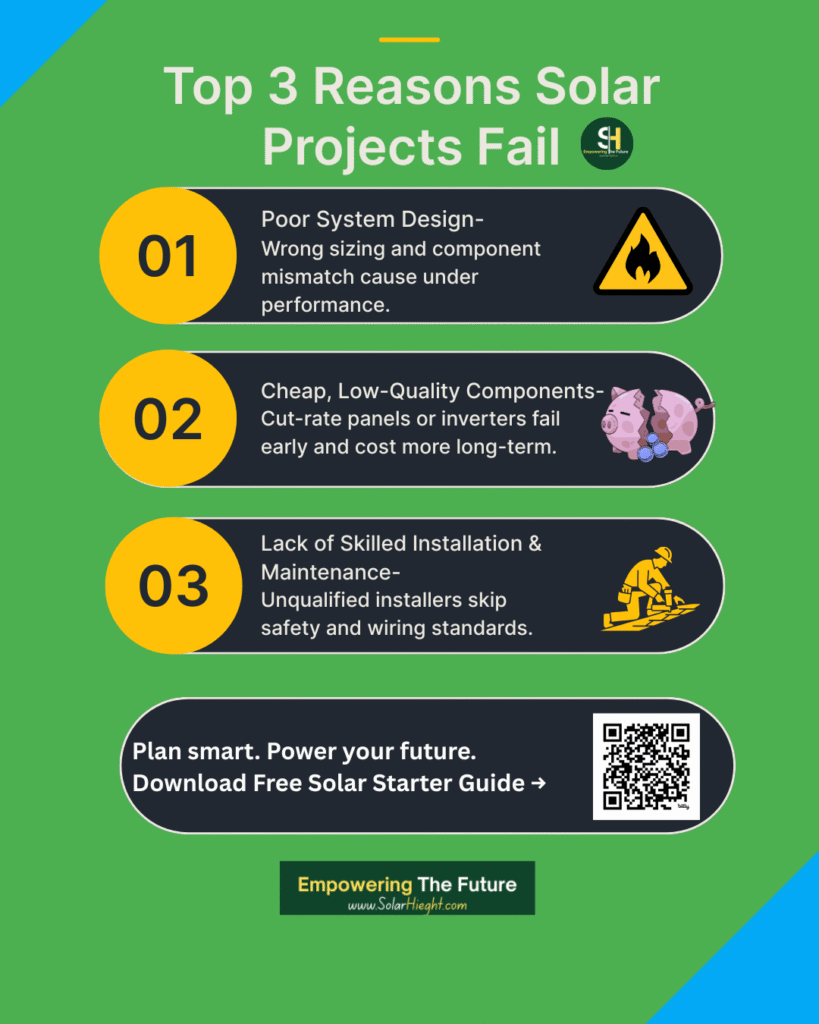
Solar is expensive. Music producer Somik Chris Ikesom told DW that while solar transformed his studio, “Installing solar these days is not cheap. It runs into millions” . This high cost leads many to seek out cheaper options, which is where the danger lies. [Internal Link to how to grow your solar]The market is flooded with cheap, uncertified batteries and panels that fail within months . This is a huge reason why many solar systems fail, not because the technology is bad, but because of “poor planning, the use of substandard materials, and unqualified workmanship” .

 5. Safety and “Quack” Installers

The desperate rush for solar has created a dangerous situation where installations are outpacing oversight . The Nigerian Electricity Management Services Agency has raised concerns about fire incidents linked to improperly installed solar systems . The panels themselves are rarely the cause; the danger is in “undersized wiring, poorly connected electrical systems, defective charge controllers, and batteries installed without adequate ventilation” . A cheap polycrystalline panel from a reputable brand is a far better investment than a “bargain” monocrystalline panel installed by a quack.

 The Verdict: Which One Should You Buy?

 Choose Monocrystalline If:

  • 1.  You have limited rooftop space in a city like Lagos or Abuja.
  • 2.  You are willing to pay a premium for maximum power generation.
  • 3.  You have the budget to buy high-quality panels from a Tier 1 manufacturer . There are no Tier 1 Nigerian panel manufacturers yet, so you will be buying imported . The government is considering a ban on imports to boost local manufacturing, but for now, careful sourcing is key .

 Choose polycrystalline If:

  • 1.  You have ample space for installation (e.g., a large compound in the suburbs).
  • 2.  You are on a tighter budget and need a cost-effective solution.
  • 3.  You plan to use a proper cooling mechanism (like a hybrid PV-thermal collector) to boost efficiency, which a study has shown can work well with polycrystalline panels in Nigeria .

 Beyond the Panel Type: Your Success Checklist

Before you spend a single kobo, do this:

At the very end, after the final “Do it right” sentence. 

  • 1.  Get a Professional Power Audit: Do not copy your neighbour’s setup! A qualified installer will calculate your exact energy needs. As Yunusa advises, “The problem has never been that solar technology doesn’t work. The real issues are poor planning” .
  • 2.  Buy Quality, Not Price: “Choosing price over quality” is one of the top five errors causing solar failures . Look for international certifications like IEC 61730 for safety and IEC 61701 for durability . A cheap panel will cost you more in the long run.
  • 3.  Hire Certified Installers: If you have to ask “how much to install?” you’re not ready. Ask “are you certified?” “Using unqualified installers and DIY shortcuts” is a recipe for disaster .
  • 4.  Maintain Your System: Neglecting maintenance is a guaranteed way to fail. Make sure you get a system that has readily available after-sales support, and clean your panels regularly, especially during the rainy season .

Read our full guide for Nigerian homes here.

In short: For a Nigerian user, the monocrystalline vs. polycrystalline debate is secondary to the primary rule: Do your research, hire a pro, and never sacrifice quality for a lower price. Your solar system is a long-term investment in peace of mind. Do it right, and you’ll be laughing all the way to the bank while your neighbours are still buying fuel.

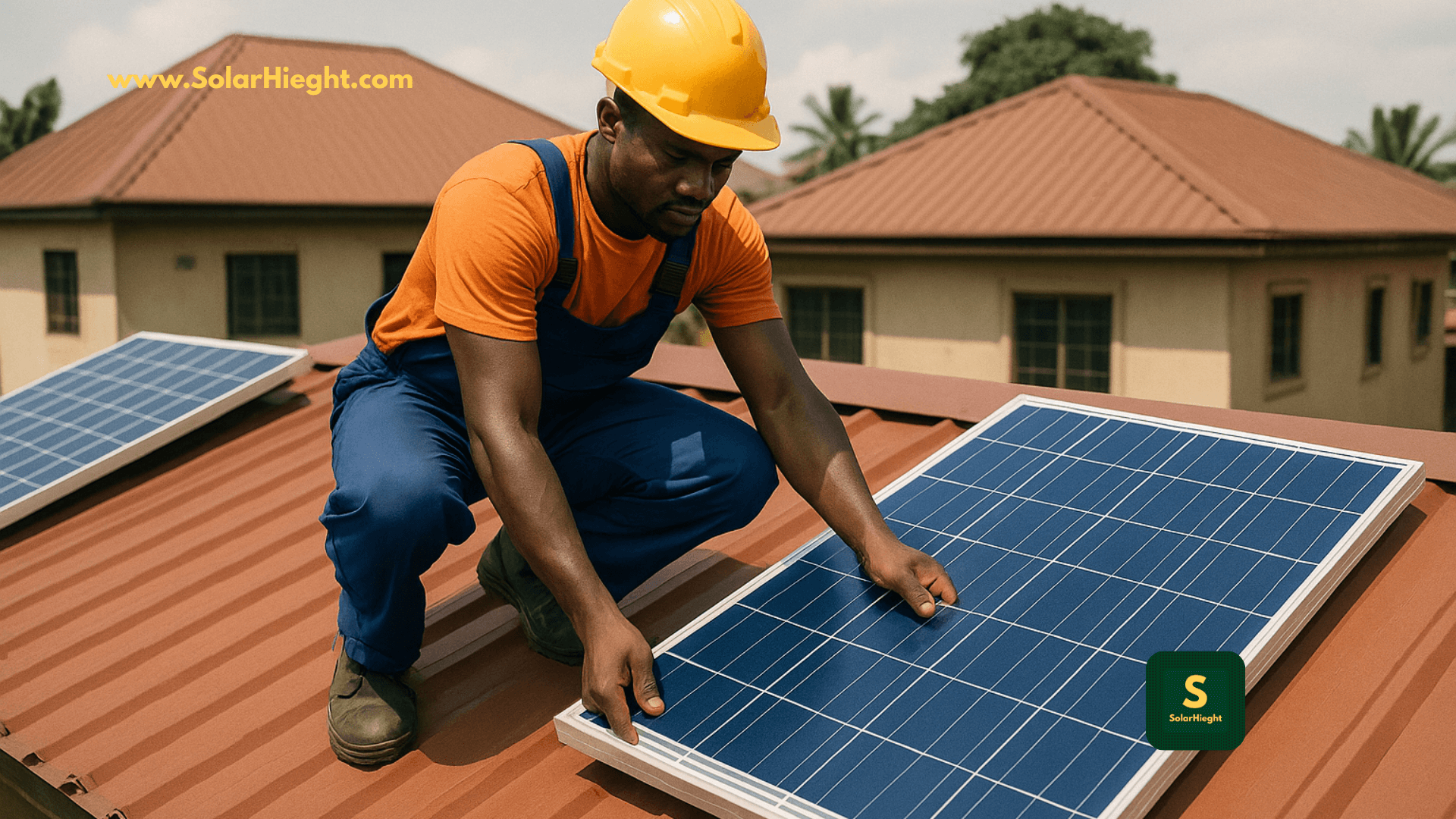
solarhieght blog featured image for the blog post the real reason solar projects fail in nigeria a professional installer working on top of a solar rooftop

Why Solar Projects Fail in Nigeria — and How to Fix It

The Real Reason Solar Projects Fail in Nigeria — And How You Can Avoid It


Introduction: The Story Behind the Failure

Last year, a friend called me in frustration.

“My ₦500,000 solar system has stopped working again!”

It wasn’t the sun’s fault — it was human error. Across Nigeria, thousands of homes face the same heartbreak: solar installations that promise freedom but collapse within months.
So, why do solar projects fail so often, and how can you avoid the same fate?


The Hidden Problem Nobody Talks About

Most failures begin before installation — with wrong information.
People buy panels or batteries because a friend said “it works for me,” not because it matches their actual power needs. Identifying energy needs is as important as investing in Solar energy. I have done justcie to this matter on  How to Choose the Right Solar Kit for Your Nigerian Home and the The Guardian Nigeria — Fake Solar Products Report gave some insight on the veracity of the problem.


1. Mistake — Wrong System Design

  • Load not calculated properly.
  • Batteries undersized.
  • Inverters chosen by price instead of rating.

Before you buy anything, calculate your wattage and daily usage.
This is, most often, the first mistake that people make. Not researching a bit about solar project and how they should approach their energy needs is a crucial mistake.. Many would rather depend on just what they are told by some unprofessional volunteers rather than rely on some well researched book or presentation or even a solar calculator.


2. Mistake — Poor Installation & Zero After-Sales Care

A neat wiring job is not enough.
Ask your installer:

  • Do you test voltage drops?
  • What’s your warranty policy?
  • Do you teach basic maintenance?

For starters, you should Download our Free Solar Kit Checklist here. It will give you an insight on how to approach any solar investments you decide to make.


3. Mistake — Neglect and No Maintenance Routine

Solar panels love attention.
A simple cleaning every two weeks can raise performance by 10–15%.
Don’t ignore battery water levels or surge protection.

Personal Touch:

“At SolarHieght, I have learned that most failures come from neglect, not the panels themselves.”


The Right Approach — Build Smart, Start Small

Start with a small, well-designed system and expand gradually.
Research component compatibility, use trusted brands, and always insist on documentation.

It would be important to take a cursory look at IRENA — Renewable Energy in Africa for expert knowledge about what you should expect before ordering those first solar products.


Conclusion + CTA

A good solar project doesn’t end at installation — it begins there.
With the right knowledge and small, consistent care, your solar system can last years without stress.

Download your free Solar Kit Checklist and learn how to build smarter.

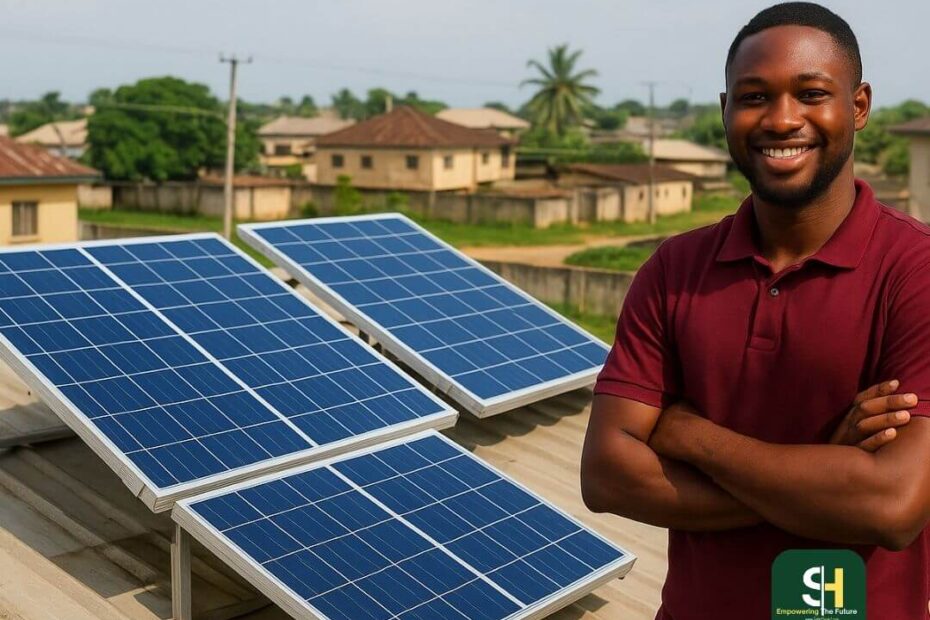
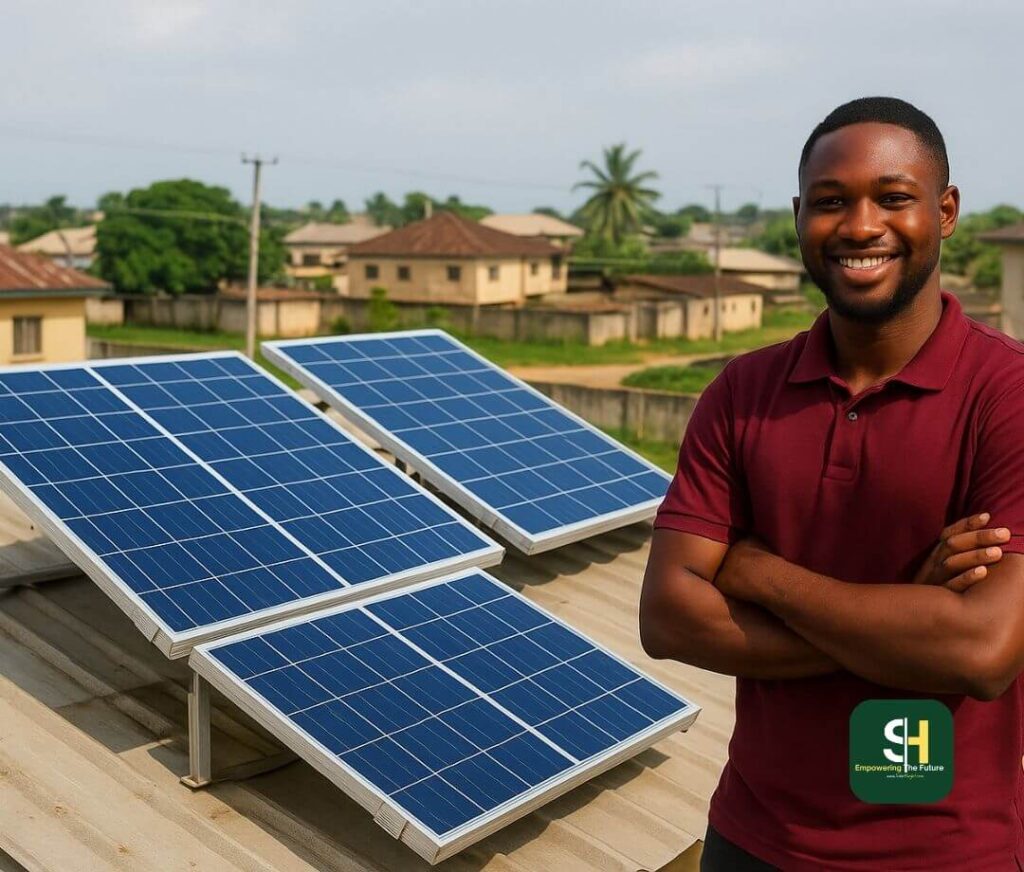
Nigerian man smiling beside rooftop solar panels in a residential area.

How to Start Small with Solar in Nigeria -And Expand Later Without Wasting Money.

Start Smart, Not Big

Solar energy can transform your home—but in Nigeria, many are still afraid of switching to solar. Why?

Because they think it’s too expensive and only for the rich. Because they’ve seen neighbors buy “complete kits” whose initial investments seem to be beyond the roof or they have seen one such investment that failed not long after it was installed. Because installers offer no real plan—just a price.

But you don’t have to go big all at once. In fact, the smartest solar journeys are those that start small, with expansion in mind. Let’s show you how to do just that.

Nigerian man smiling beside rooftop solar panels in a residential area.
Starting small with rooftop solar can save money and provide reliable power.

Why Many Nigerians Still Fear Solar

It’s not just the price. People fear solar because:

  • They’ve seen fake or mismatched products
  • Installers give them wrong or exaggerated promises
  • They try to power the entire house from Day 1
  • They don’t know what they really need

Let’s remove the fear and start from what matters most to your home today.


Plan 1: The Basic Essentials Kit (₦180,000–₦250,000)

The Basic Essentials Kit (₦180,000–₦250,000)

This is a starter kit that can power:

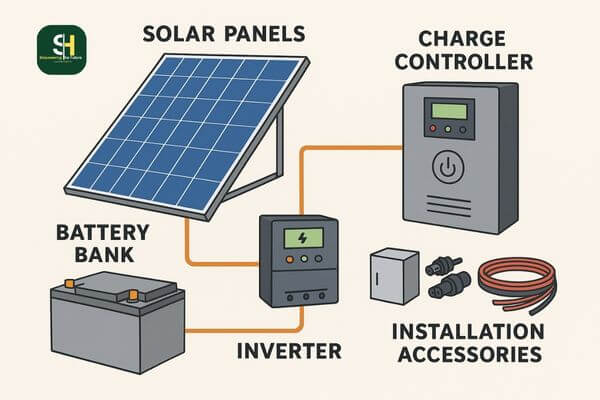
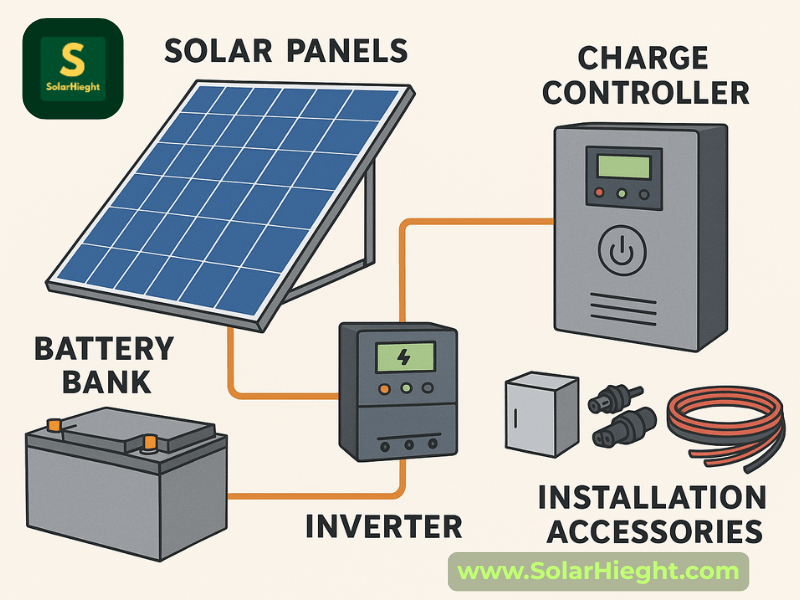
Diagram of solar panel system with inverter, battery bank, charge controller, and accessories.

✅ 3–5 energy-saving bulbs

✅ 2 charging ports

✅ 1 standing or ceiling fan

✅ 1 small LED TV

If you think this wont make any difference, experience, like I did years back in Iyakari Estate, Lagos. Several days of NEPA outages that forces people to sleep in balconies and hear a thousand rhythms of mosquito songs. The above kit can still keep you inside the mosquito-net-covered comfort of your room enjoying your TV and your fan.

Suggested Kit Components

ComponentQuantitySpecs (Minimum)
Solar Panel1200W–300W
Battery112V 100Ah (gel or lithium)
Inverter1500W–800W (Pure sine wave)
Charge Controller120A MPPT recommended
Cables & AccessoriesBreakers, connectors, etc.

Note: Choose modular components so you can add a second panel or battery later without changing the whole system.


How to Install for Expansion

If you plan smart, you can scale later without throwing money away.

Installation Tips:

  • Use a solar combiner box that allows more panels later
  • Mount your inverter and controller in a ventilated space with space for upgrades
  • Keep wiring neat and expandable—ask the installer to “leave room” for 2–3 more panels or batteries
  • Choose a hybrid inverter if you plan to mix with NEPA or generator in the future

Plan 2: Add a Small Fridge & More Appliances (₦300,000–₦500,000)

Once your basic kit is running well, you can plan for:

  • ✅ 1 small fridge (100–150L)
  • ✅ 2–3 fans
  • ✅ 1 laptop
  • ✅ Lighting backup for more rooms

Additional Kit Requirements

ComponentQuantityNew Total
Solar Panels+1400–600W total
Battery+112V 200Ah total
InverterUpgrade1.5kVA – 2kVA
Charge ControllerUpgrade30A MPPT preferred

✅ Pro Tip: Ask for batteries that can be paralleled easily, like lithium or sealed gel with fuse protection.


Quality Over Quantity: How to Avoid Wasting Money

Don’t just ask “how many watts?”—ask “which brand, which warranty, and how will I expand later?”

What to Avoid:

  • ❌ Panels with no serial number or datasheet
  • ❌ Fake lithium batteries with no capacity label
  • ❌ Inverters that “whine” or overload with small appliances
  • ❌ Mixing brands blindly (especially batteries)

Recommended Brands (Affordable & Reliable)

ComponentBudget BrandsPremium Brands
PanelRitar, Felicity SolarCanadian Solar, Jinko
BatteryBBOXX, MercuryBlueNova, Simba Lithium
InverterMust, SukamVictron, Growatt
ControllerEpever, FangpusunRenogy, Victron

Sample Kits by Budget

Budget (₦)PlanWhat It Powers
₦180,000Plan 1Bulbs, Fan, TV, Phone
₦300,000Plan 2 LiteAdd Laptop, Bigger Fan
₦500,000Plan 2 FullAdd Fridge, 2–3 Fans, Stable Charging
₦800,000+Plan 3Full 2-Bedroom Essentials + Night Backup

We’ll soon provide a free downloadable PDF checklist and an interactive calculator to help you choose the right plan.


Final Word: Solar is a Journey

Start with what you need most—power for your evening comfort, safety, and basic appliances. Then scale gradually.

A ₦180k plan today could grow into a ₦500k hybrid system next year, without wasting a kobo.

Want help choosing your starter kit?

Drop a comment, DM us, or visit our SolarHieght Starter Series for more guides.


Choosing the right solar kit for Nigerian home

Power cuts are real. But the wrong solar kit can make things worse. This post breaks down how to choose the right-sized kit for your needs — from basic lighting to full home setups.

A friend of mine, Julius, was completely fed up with the constant NEPA wahala in Lagos. Tired of blackouts and generator noise, he decided to try solar after hearing about the promise of clean energy. But like many first-timers, he didn’t realize that going solar is only half the battle — choosing the right kit is just as critical. Unfortunately, he picked the wrong components, and within a few months, his entire system stopped producing power.

Power cuts are real. But the wrong solar kit can make things worse. This post breaks down how to choose the right-sized kit for your needs — from basic lighting to full home setups.

Why Solar Power is a Game-Changer

Solar energy provides clean, renewable electricity—without the noise, fumes, or fuel costs of generators. In Lagos and most cities in Nigeria, each time NEPA takes its light, the noise that comes from peoples generators especially at nights,for most people, is almost unbearable.But imagine when that noise is taken away, by an alternative energy source that powers your house and probably that of your neighbours the same way as NEPA but without the unbearable generators noise. In addition to that, solar energy reduces your energy bills and frees you from unreliable grid power. Today’s solar kits are more efficient and affordable than ever, making them ideal for both urban and rural homes in Nigeria.


Understanding Solar Power Systems

Components of a Solar Kit

Before buying a solar kit, it helps to know the main components involved:

Solar Panels – Capture sunlight and convert it into electricity.
Inverter – Converts DC (direct current) to AC (alternating current) used in your home.
Battery Bank – Stores excess energy for nighttime or cloudy days.
Installation Accessories – Includes wiring, fuses, and mounting kits.
Charge Controller – Manages the power flow from the panels to the battery.
#basic-solar-kit-components-for-nigerian-homes

Off-Grid vs. Hybrid vs. Grid-Tied Systems

  • Off-grid systems are self-sufficient and ideal for rural areas without access to the national grid.
  • Hybrid systems combine solar power with grid or generator backup, offering flexibility.
  • Grid-tied systems feed excess power into the grid but are less common in Nigeria due to unreliable infrastructure.

Assessing Your Home’s Energy Needs

Calculating Your Daily Energy Consumption

Start by listing your appliances, their power ratings (watts), and estimated daily usage.

ApplianceWattageHours/DayDaily Usage (Wh)
TV100W5 hrs500Wh
Fridge150W24 hrs3600Wh
Lighting60W6 hrs360Wh
Total4460Wh

This total gives you a realistic idea of the system size you’ll need.

Identifying Power-Hungry Appliances

Some appliances, like air conditioners and water heaters, consume a lot of power. You can either size your system to accommodate them or replace them with energy-efficient alternatives.


Factors to Consider When Choosing a Solar Kit

Power Rating and Battery Capacity

Always size your system slightly above your needs to account for inefficiencies and future expansion.

Quality of Components

Look for:

Tier-1 solar panels
Pure sine wave inverters
Lithium-ion batteries (for durability and lifespan)

Scalability and Expansion Options

Choose a kit that allows you to add more panels or batteries as your power needs grow.This is very core to my previous “How to Start Small with Solar in Nigeria (And Expand Later Without Wasting Money)” Even when you start with the smallest unit, have it at the back of your mind to choose items that allows your system to grow. That way you wont be throwing away any money.Treat the solar experience as  “a marathon and not a 100 meter dash”. That way you will get the best out it without wasting money.


Solar Panel Types and Their Efficiency

Monocrystalline vs. Polycrystalline Panels

  • Which Type Suits Nigerian Weather Best?.
  • Polycrystalline panels are cheaper but slightly less efficient
Visual comparison between monocrystalline and polycrystalline solar panels

☀️Monocrystalline panels

High-efficiency, sleek-looking panels that work well in all weather and last longer. Ideal if you want top performance and durability.
Color: Dark blue or black
☀️ High Efficiency and compact,
————————————
Performs better in low light
🖤 Darker color
Premium design
⚡️ Long-term value

More affordable, slightly less efficient, and great for large roofs. A good choice if budget is a major factor.
Color: Blue or light gray
🌤 Lower Cost
——————————–
Less efficient
Needs more space
🔷 Bluish tint
Budget-friendly
💸 Affordable starter option


Battery Storage Options for Nigerian Homes

Lead-Acid vs. Lithium-Ion Batteries

  • Lead-acid batteries: Affordable but bulky, with more maintenance needs.
  • Lithium-ion batteries: Longer lifespan, faster charging, and compact design.

Runtime and Depth of Discharge (DoD)

Higher DoD means more usable energy. Lithium batteries usually offer 80–90% DoD, making them more efficient.


Inverter Selection and Its Importance

Pure Sine Wave vs. Modified Sine Wave

Always choose a pure sine wave inverter. It ensures a smooth flow of power and protects sensitive electronics.

Inverter Sizing Guide

  • A 3kVA inverter is suitable for a small home.
  • A 5kVA+ inverter is better for homes running heavy-duty appliances.

Importance of Charge Controllers

PWM vs. MPPT Controllers

  • PWM (Pulse Width Modulation) controllers are cheaper but less efficient.
  • MPPT (Maximum Power Point Tracking) controllers are costlier but maximize battery charging, especially in cloudy conditions.

Safe Charging Tips

Match your charge controller to your panel’s voltage and battery bank size to avoid short circuits or poor battery health.


Budgeting for a Solar Kit in Nigeria

Price Range of Solar Kits

System SizeEstimated Cost (₦)
1kVA₦150,000 – ₦300,000
3kVA₦400,000 – ₦700,000
5kVA+₦800,000+

Cost vs. Value

Avoid cutting corners. Investing in quality components saves money in the long run through fewer repairs and longer lifespan.


Installation: DIY vs. Professional Setup

Pros and Cons of Self-Installation

Solar technician installing a 3-panel system on a rooftop in Nigeria

DIY setups can save money but may void warranties and pose safety risks if not done properly.

Why Hire a Certified Technician?

Professionals ensure safe wiring, optimal panel angles, and full compliance with Nigerian electrical codes.


Government Policies and Incentives

Available Subsidies or Tax Breaks

While limited, some state-level incentives exist—especially for rural electrification projects.

Regulatory Approvals

Ensure your system meets the Nigerian Electricity Regulatory Commission (NERC) standards.


Common Mistakes to Avoid

  • Undersizing your system: Plan for future needs, not just today.
  • Skipping maintenance: Clean your panels regularly and monitor battery health.

Real-Life Success Stories in Nigeria

  • Lagos & Kaduna: Families are ditching noisy generators for rooftop solar systems. This situation is replete in many parts of the country.
  • Imo & Enugu: Off-grid communities are now powered with affordable solar kits for homes, clinics, and schools. In my village, Amurie Omanze, there is an extensive use of community effort to install solar streets lights in virtually all the parts of the village. Such project would not have been possible running on fuel.

Maintenance and Longevity Tips

Cleaning Solar Panels

Dust buildup reduces efficiency. Clean panels with a soft cloth and clean water every 2–3 weeks.

Battery Maintenance

  • Keep batteries cool and dry.
  • For lead-acid: Check water levels regularly.
  • For lithium-ion: Use monitoring apps to track performance.

Where to Buy Reliable Solar Kits in Nigeria

Trusted Brands and Suppliers

  • Brands: Luminous, Felicity, Sukam, Bluegate
  • Retailers: SolarKobo, Rubitec, Lumos Nigeria

Warranty Tips

  • Look for a 25-year warranty on solar panels
  • 5–10 years on inverters and batteries

Frequently Asked Question(FAQs)


Conclusion

Switching to solar in Nigeria is no longer a luxury—it’s a necessity. With careful planning, quality components, and the right guidance, you can build a system that powers your home reliably for years to come.👉 Ready to start? Download our free starter checklist or contact us to help you pick the right solar kit for your needs.

Clean Energy in Nigeria

Why Nigeria Needs Solar Now


The rising cost of petrol in Nigeria is a growing concern — and electricity supply remains unpredictable in many parts of the country. But there’s good news: the sun is free, abundant, and ready to power our future. This short post looks at the urgent need for clean energy in Nigeria and how solar is already making a difference in homes, villages, and small businesses.
We’ll be diving deeper with data, stories, and actionable steps in an upcoming post.