Why do people still patronise generators despite the data that shows that it is not cheap in the long run? Does the Nigerian government really appreciate the enormous fund that is wasted in the generator economy? Could it not make sense to block this hole and find ways to redirect these wastages elsewhere? Who is benefitting from increased investment in this economy? Is the generator economy the reason our National Grid is still in shamble?
A few years ago, the promise of solar in Nigeria brought formidable changes in the Nigeria energy architecture. It started in small places and small things. With our touches, fans , a few bulbs, charging pots etc. Then it progressed to powering homes, businesses etc. Within a short time, Nigerian business ingenuity found ways to crash the prices. Solar became affordable for people and in places that had suffered untold energy hardship. That promise resonated and consequently Solar became a thriving economy.
But recently, that dream seems to be fading with the high rise in solar materials. While the rise in prices could be explained by enormous upfront costs of solar materials, changes in solar manufacturing subsidies and foreign exchange volatility, it has also seen a retreat by people back to generators thereby providing sustenance to that economy. But that believe that generator economy entry point is cheap is a story that we have been sold. And it’s costing us everything.
Last three weeks, we explored why solar has become a luxury only the rich can afford- how a system that cost ₦800,000 just a year ago now goes for up to ₦4 million, pricing out the very people who need it most.
It seems to support the age-long investment in generators still as a credible cheaper source of power generation. But here’s the uncomfortable truth we must confront: Generator is also not cheaper. It looks so at a face glance but it is not. We have actually been pouring billions into generators, without noticing it as we did with solar and the real issue is that we have been paying for a lie.
The generator economy in Nigeria is not a solution. It is a trap. A $16 billion annual trap that is draining our economy, killing our people, and keeping us in darkness while we pretend we are “managing.”
The Numbers that Should Shock You
Let’s start with the scale of this crisis.
The International Monetary Fund (IMF) estimates that Nigerians spend $14 billion annually on petrol for generators alone – surpassing the nation’s entire education and health budgets combined.
But that’s just the beginning.
A comprehensive analysis by economist Martins Itua, Director of Arthur Group, paints an even more staggering picture. According to his projections, if five million households and small enterprises consume a conservative average of four litres of petrol daily, the collective fuel bill surpasses ₦26 billion each day.
When factoring in heavy industrial diesel used by banks, supermarkets, and manufacturing plants, the national daily fuel bill for self-generation approaches ₦60 billion.
That translates to roughly ₦1.8 trillion every month and nearly ₦22 trillion annually.
How Big Is This Shadow Economy?
The scale of Nigeria’s generator dependence is without parallel among major economies.
The country of more than 220 million people generates, on average, only a fraction of the electricity its population and industries require. The national grid, with an installed capacity of over 12,000 megawatts, consistently generates less than 5,000MW – woefully inadequate for a nation of this size.
The International Finance Corporation (IFC) reports that Nigeria is among the top six countries globally – alongside India, Iraq, Pakistan, Venezuela, and Bangladesh – with the highest backup generator usage. The IFC estimates Nigeria’s installed generator capacity at 15-20 gigawatts, compared to just 5-15 GW from the grid.
A study by Dalberg found that the collective capacity of small petrol generators in Nigeria is eight times the capacity of the national grid. The firm estimates that around 22 million households and businesses rely on such units, with annual spending on acquisition and fuel reaching $12 billion.
That is the generator economy – a shadow power system more than eight times larger than the official grid.
The Human Cost: Businesses Drowning in Fuel Bills
The statistics are one thing. The human cost is something else entirely.
Mama Nkechi, a restaurant owner in Surulere, Lagos, represents millions of small entrepreneurs trapped in this system. She told BusinessDay:
“If I don’t use my generator, my food will spoil, and customers will leave. But fuel costs are eating up my profits. Sometimes I spend more on petrol than ingredients“.
A survey by the Nigerian Tribune reveals that most businesses are struggling, making little profit, trying to stay afloat due to the high cost of operations fuelled by alternative power sources. Businesses like cafe outlets are folding up due to the non-availability of electricity and the high cost of fuelling generators.
The numbers are devastating:
– Operating a 100kVA generator typically costs over ₦1 million monthly
– A typical business with a 100kVA generator can spend over ₦1,071,250 monthly on fuel and maintenance
– Running a small 5kVA generator for 6 hours daily costs roughly ₦4,000–₦8,000 for fuel
– Some small businesses spend up to 40% of their income on energy generation
This is not a solution. This is a tax on survival.
The Economic Black Hole
According to Sustainable Energy for All (SEforALL), in partnership with the Lagos State Government, Lagos residents alone spend $10 billion annually on fuel and generator maintenance.
But the costs go far beyond fuel bills.
The African Development Bank’s African Economic Outlook 2026 report found that power outages are costing Nigerian businesses an estimated 3% of their annual sales, forcing firms to spend heavily on alternative power sources.
According to the report, 70.7% of Nigerian firms own or share generators, highlighting the extent to which businesses have turned to self-generation to cope with electricity shortages. Nigeria recorded one of the highest levels of generator dependence among the countries referenced in the report, ahead of South Africa (63.3%) and Tanzania (38.7%).
Electricity outages account for losses equivalent to three per cent of annual sales in Nigeria.
When factoring in wider systemic issues – including disrupted production lines, damaged equipment, and spoiled agricultural goods – the broader economic cost of unreliable power exceeds ₦48 trillion annually.
At current exchange rates, this represents a yearly loss of over $35 billion. With the federal budget standing at approximately ₦55 trillion, the nation is losing an amount nearly equivalent to its entire federal spending package every single year.
The Health and Environmental Catastrophe
The economic cost of Nigeria’s energy crisis is only part of the story. The health and environmental consequences are equally dire.
The World Health Organisation (WHO) estimates that generator emissions are responsible for more than 20,000 premature deaths annually, largely due to respiratory complications.
The noise pollution is another issue. In many cities across Africa’s largest oil producer, one sound is inescapable: the incessant hum of generators. From the high-rises of Victoria Island to the congested stalls of Alaba market or that of Ariaria Market, nearly every home and business in Nigeria depends on generators to keep the power flowing.
A 2025 academic study analyzing the comparative cost- benefit analysis of solar versus generators in Lagos found that the pollution-related economic costs that the average Nigerian household incurs due to a lack of stable electrical power are immense. The study highlights the “lack of affordability and accessibility” to more economically and environmentally sustainable alternatives for backup power.
We are burning money to poison ourselves. And we call it “managing.”
The Structural Failure Behind the Numbers
So why do we continue this insanity?
According to Chidi Okonkwo, an energy analyst at Lagos-based Frontier Economics:
“This is not just a fuel story. This is a story about the structural failure of the Nigerian state to deliver basic infrastructure, and what that failure costs in real money, every single day”.
Economists have long argued that the failure to secure reliable grid electricity has exacted an incalculable socio-economic toll over more than three decades. The cost is not merely financial but structural, eroding Nigeria’s competitiveness, deterring foreign investment, and projecting to the outside world an image of a country unable to guarantee its own most basic productive inputs.
Since 2010, Nigeria has recorded at least 222 partial and total grid collapses. Generation crashed from 3,825 megawatts to 39 megawatts in minutes—a country of over 200 million people, plunged into darkness, again.
Meanwhile, more than six in ten manufacturing firms have abandoned the national grid entirely. Manufacturers now spend over ₦45 trillion a year on diesel, petrol, and captive generators just to keep their factories running.
The result? Nearly 19,000 manufacturing jobs lost in the first half of 2025 alone. An estimated ₦10.1 trillion lost every single year to a power sector that cannot deliver power.
The Diesel Crisis Worsens
The situation has only deteriorated further.
Surging diesel prices are threatening to choke Nigeria’s vast generator economy. The price of diesel has climbed to as high as N1,650 per litre in parts of the country.
The reasons include:
– Conflict in the Middle East tightening supplies of both industrial fuel and the grades of crude oil best suited to produce it
– Ukrainian drone strikes on Russian refineries and Western sanctions on Moscow’s energy exports
– The naira’s depreciation following the removal of the currency’s longstanding peg, meaning internationally priced commodities like diesel now arrive at a far more punishing exchange rate
Small and medium-sized enterprises, which form the backbone of Nigeria’s non-oil economy, are among the hardest hit. Manufacturers report that energy costs, already accounting for a disproportionate share of their operating expenses, are squeezing margins to the point where production cutbacks are becoming unavoidable.
“Every time diesel goes up, something has to give,” said the owner of a printing business in Lagos’s industrial suburb of Isolo. “Either we raise prices, we cut staff, or we shut a shift. There is no fourth option”.
Why Not Just Switch to Solar?
This is where we return to the theme of our previous post.
A Nigerian Tribune investigation found that solar installation is very expensive, with one business owner spending close to N5 million to install solar in his shop. Many businesses cannot afford this upfront cost, even though solar would save them money in the long run.
A 2024 academic study identified that citizens could mostly afford low-capacity solar installations, but medium-capacity solar was found to be “quite unaffordable”. The study identified affordability as a “showstopper” in incorporating solar effectively into Nigeria’s energy mix.
This is the cruel irony: the only solution that works long-term is out of reach for the people who need it most.
The Parallel Economy: A System That Rewards Failure
What we have created is a system that rewards the failure of the grid.
A LinkedIn analysis of Nigeria’s “Dual Energy System” describes this dynamic perfectly:
“Nigeria’s challenge is not a lack of solutions. It is a system-wide trust deficit across: Power (Generators vs Solar) and Mobility (ICE vs EVs). In both cases, the market defaults to: What works consistently today, not what promises efficiency tomorrow”.
The analysis continues:
“Nigeria is not resisting transition. It is managing risk. Generators and petrol vehicles represent certainty and control. Renewable energy and electric mobility represent efficiency and the future. The shift will happen when the ‘future’ becomes: Reliable, Accessible, Commercially trusted at scale. Until then, both systems will continue to run in parallel”.
This is the lie: that generators represent “certainty.”
They represent certainty only in their cost. Certainty in their pollution. Certainty in their noise. Certainty in their ever-increasing burden on the Nigerian family and business.
A Glimmer of Hope: The Quiet Transition
Despite everything, change is happening – not because of government policy, but because simple economics is forcing it.
Across Nigeria’s roughly 14,000 licensed filling stations, a quiet but accelerating transition is underway. Operators who spent decades treating diesel generators as an unavoidable cost of doing business are now choosing solar and battery storage instead.
The trigger was the fuel subsidy removal of May 2023. A litre of diesel that cost N750 in early 2023 was trading above N1,600 by the middle of 2024. For a large station running two generators around the clock, the monthly fuel bill could easily exceed N3 million.
At the same time, the landed cost of solar panels in Nigeria has fallen sharply. Chinese manufacturers, facing overcapacity at home and tariff pressure in Western markets, have redirected exports to Africa. Industry figures suggest the cost of a commercial rooftop solar installation fell by roughly 35 percent in naira terms between 2022 and 2025, even accounting for currency depreciation.
The numbers now work:
A mid-sized station consuming roughly 200 kilowatt-hours per day might spend between N35 million and N55 million on a solar-plus-storage system. At current diesel prices, the same station was spending N80 million or more per year on generator fuel. Payback periods of 18 to 30 months are now routinely cited by installers
The Petroleum Products Retail Outlets Owners Association of Nigeria estimates that fewer than 12% of the country’s stations have so far made a full or partial switch to solar – but that share has nearly tripled since 2023, and association officials expect it to double again within two years.
The Path Forward: Ending the Lie
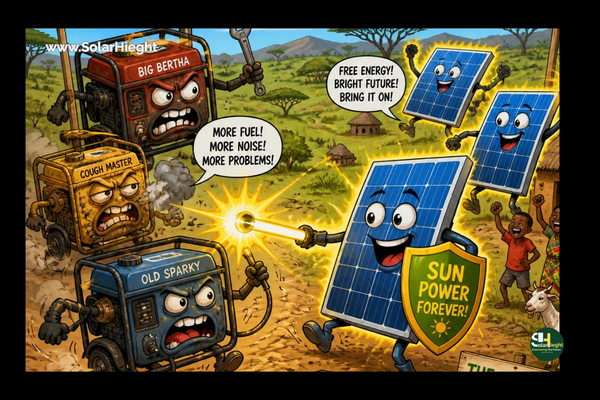
The “Generator Economy” in Nigeria is a $16 billion lie because it pretends to be a solution when it is, in fact, a symptom of failure. We have been sold the idea that generators are “managing.”
But managing has cost us:
– ₦22 trillion annually in fuel alone
– 20,000 premature deaths from generator emissions
– 70% of businesses dependent on self-generation
– 3% of annual sales lost to outages
– 19,000 manufacturing jobs lost in six months
The lie is this: that we can’t afford to fix the grid.
The truth is that we can’t afford not to. We are already paying – in fuel bills, in lost productivity, in dead citizens, in a nation that cannot industrialise.
As economist Martins Itua puts it:
“A nation cannot industrialise in darkness. A country cannot become globally competitive when millions of its citizens spend productive hours solving an infrastructure problem that should have been resolved by the state”.
He estimates that upgrading the national electricity supply to a stable 25,000 megawatts within four years would unlock massive latent growth across manufacturing, digital services, and agricultural processing, creating a viable path to double the size of the Nigerian economy from $400 billion to $800 billion within a single presidential term.
The “Generator Economy” is not an economy. It is a tax on our collective future.
This post has been a follow-up to “The N4 Million Nightmare” and our exploration of why solar has become a luxury only the rich can afford. But it’s also part of a larger series on why Nigeria’s energy transition is failing the very people it should help.
We need to have an honest conversation about the generator economy – not as a solution, but as the failure it truly is.
Questions for reflection:
1. How much do you spend on fuel for your generator every week? Every month? Every year?
2. What would you do with that money if you didn’t have to spend it on fuel?
3. How many businesses in your community have closed because they couldn’t afford the cost of self-generation?
4. What would it take for you to finally break free from the generator trap?
Share your story. Your experience matters. Because the generator economy is not just a statistic – it is a daily reality for millions of Nigerians. And the only way to change it is to name it for what it truly is: a $16 billion lie.
Advice for Users: Stop buying oversized inverters you don’t need. Datadriven, modular solar generators are cheaper, scalable, and offer a better ROI than maintaining a noisy, fumeemitting petrol generator.