Skip to content
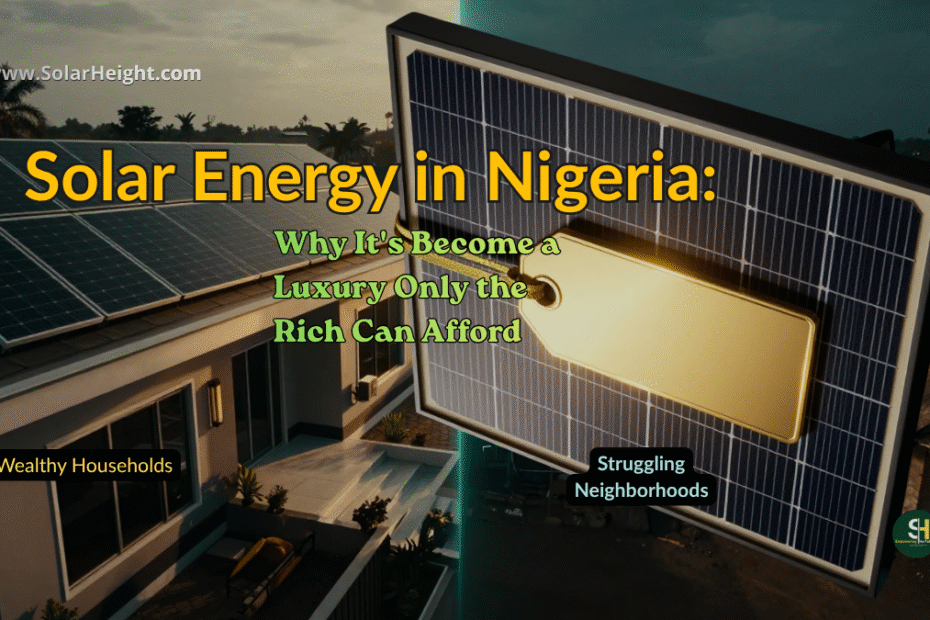
An llustration of solar panels of the rich and the poor indicating the increasing high prices of solar and the consequences of pushing solar dreams out of the reach of many Nigerians as shown in the post

 The N4 Million Nightmare: Why Solar Is Now a Luxury Only the Rich Can Afford (Despite Nigeria Being in Darkness)

The grid is down. The generators are guzzling fuel. And the one solution that could actually work is now to price out the very people who need it most.

Last week, we talked about solar fires. But before then, we drew attention to the trend in migration of the rich from the National Grid to solar energy at a frequency never seen before. We explained what the consequences portend for those who cannot afford the migration and who must, therefore, stay with the National grid. But in this blog post we shall explore the high cost of solar installations and why it seems to have become, almost , an exclusive reserve of the rich. Then, it may make more sense to check whether the incidence of solar fires – the terrifying reality of quack installers, counterfeit panels, and homes going up in flames is an indicator to the desire to go solar by all means necessary. Does this urgency mean avoiding critical considerations that should be made before the first solar panel is installed or that the fire is just the final symptom. But as we may learn in the following excerpts, the real crisis is deeper, more systemic, and more heartbreaking.

The crisis is that solar has become a luxury only the rich can afford.

A standard solar setup that cost ₦800,000 just a year ago now goes for up to ₦4 million—and sometimes more. For a country where 90 million people live without reliable electricity, where the national grid generates less than 5,000 megawatts for over 200 million citizens, this isn’t just an inconvenience. It’s a betrayal. 

 The Darkness We All Know

Let’s start with the problem we all know too well.

The Nigerian grid is a tragedy in slow motion. Since 1999, every president has had an “emergency power plan.” We’ve taken over $4 billion in World Bank loans for the power sector. President Obasanjo alone is claimed to have spent $16bn on Power from 1999 to 2007. Yet the grid, with installed capacity of about 13,000MW, can barely hold 5,000MW any more and it literally collapses. 

The numbers are staggering:

 22 million generators across the country, with a combined capacity of 42,000MW – eight times what the grid delivers 

 Nigeria has more generator capacity than grid capacity

 In the first half of 2025 alone, manufacturers spent ₦676.6 billion on alternative power—and still couldn’t meet their needs 

 That translated to 18,935 jobs lost 

 The World Bank estimates power outages cost Nigeria $29 billion annually—about 10% of GDP 

Compare this to other African nations. Egypt added 14,000 megawatts of gas capacity in six years. Ghana fixed its power crisis and now exports surplus electricity. South Africa just went 300 consecutive days without load shedding after committing to a real recovery plan. 

Nigeria has been “fixing” the power problem for 25 years. We are still in the dark.

 The Solar Boom—and the Price Explosion

For a moment, there was hope. Solar prices had been falling globally for a decade – dropping roughly 90% since 2014. Rooftop solar became one of the most credible electricity solutions in a country where grid power remains erratic. On this site we explored the possibility of going solar, starting with as little as 80,000 Naira. We showed a step by step approach to power freedom.

But that trajectory has reversed.

A convergence of forces is pushing solar prices higher: China’s VAT export rebate reform, rising raw material costs, and the ripple effects of global instability. 

Here is what happened:
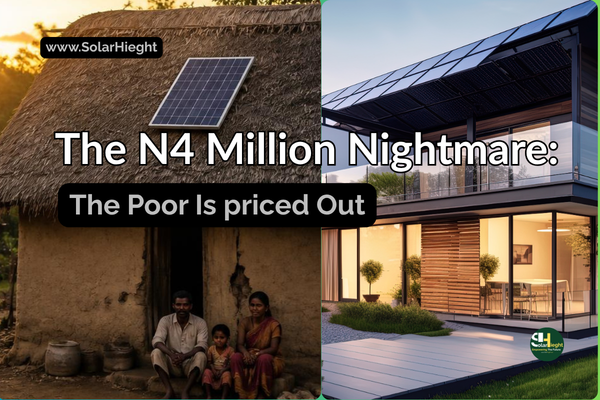
A tale of two words- showing a side by side image depicting one solar panel  on the roof of the poor house and many on the roof of the rich house showing how the poor is being priced out from going solar in Nigeria.

China controls more than 80% of the global solar manufacturing supply chain. For years, fierce competition among Chinese manufacturers kept prices artificially low – so low that Chinese solar companies collectively recorded net losses of about $5 billion. 

Beijing’s response was structural. From 1 April 2026, China eliminated a 9% VAT export rebate on solar products entirely and reduced the rebate on batteries from 9% to 6%. That battery rebate disappears completely on 1 January 2027. 

The market felt the impact immediately.

 A 590W panel that sold for between N125,000 and N130,000 in January 2025 now sells for between N143,000 and N145,000 

 A 620W panel increased from N138,000–N145,000 to as much as N155,000 

 A 720W panel now sells for as much as N180,000 

These increases may seem modest per panel, but multiply them across an entire installation. A typical 5kW hybrid solar system cost between N4.2 million and N5.5 million in January. By June 2026, the same installation cost had risen to N4.5 million–N5.8 million. 

Nigerians who delayed installing solar by six months are now paying between N200,000 and N300,000 more. Commercial customers are feeling even greater pain – a 20kW installation now costs N300,000–N500,000 more than it did just months ago. 

“I want to switch to solar, but the price is too high now. Every time I check, it has increased again,” a Lagos shop owner lamented. 

 The Hidden Crisis: Why Lithium Batteries Are the Main Culprit

So where does the money go? Let’s look at the numbers.

A Lagos resident, Damilola Oladipo, recently installed a solar system that cost roughly ₦5.7 million. Here’s the breakdown: 

 Solar panels (12 × N115,000): N1,380,000

 16kWh battery: N2,700,000

 8kWh inverter: N1,100,000

That battery is nearly half the total cost – and the price has only climbed since then.

Lithiumion batteries (specifically LiFePO4, the safest and most common chemistry for home solar) are the single biggest cost driver in modern solar systems. The upfront cost for a 15kWh lithium battery is about ₦2.3 million compared to about ₦900,000 for a tubular leadacid battery of equivalent nominal capacity. 

A lithium battery costs about ₦230,000 – ₦320,000 per kWh. 

Why are lithium batteries so expensive? They rely on materials like lithium, cobalt, and nickel – all subject to global supply chain volatility, currency fluctuations, and geopolitical instability. And the problem is that Nigeria imports virtually all of them.

The Real Question: Are Lithium Batteries Actually Worth It?


Factor Tubular Lead-Acid Lithium (LiFePO₄)
Upfront Cost (15kWh) ~₦900,000 ~₦2,300,000
Usable Capacity (Depth of Discharge limit) 50% (7.5kWh usable) 90–95% (13.5kWh+ usable)
Lifespan 2–3 years 15–20 years
Replacements in 10 years 3–4×
10-Year Battery Cost ₦3.6M – ₦4.8M ~₦2.3M (once)
Maintenance Water topping, terminal cleaning None
Gas Emissions Yes (hydrogen – ventilation required) None
Cost per kWh ~₦92,000/kWh (upfront) ~₦230,000/kWh (upfront)
Levelized Cost of Storage (over 15 years) ~₦127/kWh ~₦98/kWh

When you spread the cost over time, lithium batteries are often the better deal. A 15kWh tubular battery bank only gives you 7.5kWh of usable energy (50% depth of discharge limit to preserve battery life). A 15kWh lithium bank gives you 13.5kWh+ usable. You effectively need nearly twice the tubular capacity to match a lithium bank.

One analysis found that while tubular batteries are cheaper upfront (₦92,000/kWh vs. ₦230,000/kWh for lithium), they incur higher operation and maintenance costs (₦46,000/kWh every 5 years) and require replacements at years 5 and 10. Over 15 years, the total cost of tubular batteries actually exceeds the cost of lithium – and lithium delivers a lower levelized cost of storage (₦98/kWh vs. ₦127/kWh for tubular). 

That said, the reality is that many Nigerians simply cannot afford the upfront cost of lithium batteries – even if they had save money in the long run. A 15kWh lithium battery at ₦2.3 million is out of reach for most households, even if it lasts 15 years without replacement.

 The Solar Poverty Gap

This is where we confront the true tragedy of Nigeria’s solar transition.

A 2024 academic study found that citizens could mostly afford lowcapacity solar installations, but mediumcapacity solar was found to be “quite unaffordable.” The study identified affordability as a “showstopper” in incorporating solar effectively into Nigeria’s energy mix. 

In other words, the middle class is being priced out of the only reliable power source.

 Lowcapacity solar (1KVA, about ₦550,000) remains somewhat affordable 

 Mediumcapacity solar (2.5KVA, about ₦1.9 million) is “quite unaffordable” 

 Highcapacity solar (5KVA, about ₦2.3 million+) is unaffordable for most Nigerians 

One industry professional quoted in a BusinessDay editorial put it bluntly: “In Nigeria, however, the middle class or the poor, two demographics that should be at the forefront of this transition, are being left behind.” 

 What About the Government’s Celebrations?

While Nigerians struggle to afford solar, the government is celebrating.

The Rural Electrification Agency (REA) recently announced that Nigeria has attracted $425 million in investments for the establishment of eight renewable energy manufacturing facilities. 

“We have moved from about 120 megawatts of local manufacturing capacity to roughly 300 megawatts today, with 3.7 gigawatts in the pipeline,” said REA Managing Director Abba Aliyu. 

“For the first time, Nigeria is producing solar panels locally, and they are already being exported” from Lagos to Accra, Ghana. 

On the surface, this sounds like progress. And in many ways, it is. But there’s a glaring contradiction:

While the government celebrates domestic manufacturing, solar prices continue to rise for ordinary Nigerians.

Worse, there’s a looming threat that could make things even more expensive: a proposed import ban on solar panels to protect domestic manufacturing. Industry stakeholders warn that such a ban could raise solar system prices by as much as 150% without adequate local capacity to fill the gap. 

The same editorial warned: “Nigeria’s move to restrict the importation of solar panels… risks exacerbating the country’s deeprooted energy crisis… premature, poorly timed, and potentially selfdefeating.” 

 So What’s the Solution?

We cannot afford to wait for the grid to magically fix itself—it has been 25 years. And we can’t afford to keep paying N4 million for solar.

Here are three practical paths forward that acknowledge the reality of the moment:

 1. Reconsider the Battery Choice

Given that lithium batteries cost 23 times more upfront than tubular batteries, it’s worth asking:

Could we shift back to tubular batteries for basic loads?

For households with moderate power needs- lights, fans, phone charging, small appliances—a well maintained tubular battery bank might be the most cost effective option in the short term.

The tradeoff is clear:

 Tubular: Lower upfront cost, but requires maintenance (water topping, terminal cleaning), has half the usable capacity, and needs replacement every 23 years 

 Lithium: Higher upfront cost, but zero maintenance, deeper usable capacity, and lasts 1015 years 

For someone who cannot afford N2.3 million for a lithium battery, a N900,000 tubular battery, even with its limitations, might be the only realistic path to solar power.

 2. Advocate for Local Assembly to Beat the FX Crisis

Nigeria’s solar prices are tied directly to the exchange rate. As long as we import everything, prices will remain volatile and high.

The $425 million investment in local manufacturing is a genuine ray of hope. But it needs to focus not just on panel assembly, but on battery production—the single biggest cost driver. 

The government should also:

 Maintain low or zero tariffs on highefficiency solar imports in the short term 

 Offer targeted incentives (tax relief, concessional financing) for local manufacturers 

 Partner with global technology leaders to accelerate knowledge transfer 

 3. Push for Rent to Own and Financing Models

If Nigerians can’t afford the upfront cost of solar, the solution is to make it accessible through financing.

Some companies are already offering solar on a “payasyougo” basis. These models need to scale rapidly, with government backing and consumer protection.

 The Bottom Line

The Nigerian solar crisis is a crisis of affordability.

The grid is broken. Generators are too expensive to run. Solar is the only answer – but it’s becoming a luxury only the rich can afford.

This is not just an energy problem. It’s a poverty problem. A justice problem. A problem that is pushing the middle class back into darkness while the rich power their homes and businesses on clean energy.

We need a national conversation about how to make solar accessible to everyone, not just those who can afford to spend N4 million.

What’s at stake?

 The 90 million Nigerians without reliable electricity 

 The small businesses that can’t afford to scale because of power costs

 The families who spend half their income on fuel for generators

This is not just an inconvenience. It is a barrier to economic opportunity, education, and human dignity.

 A Call to Action

This post has been a followup to our exploration of solar fires and The Great Defection. But it’s also part of a larger series on why Nigeria’s energy transition is failing the very people it should help.

In the coming weeks, we’ll explore:

 The Generator Economy: Why the $16 billion generator industry is a lie that’s holding us back

 Beyond the Village Light: What real rural electrification would actually look like

For now, here is my question to you:

If you have solar- or are thinking about it – what’s your experience with the cost? Have you been priced out? Have you found a solution that works?

Share your story in the comments or reach out directly. We need to start talking honestly about the choices Nigerians are forced to make.
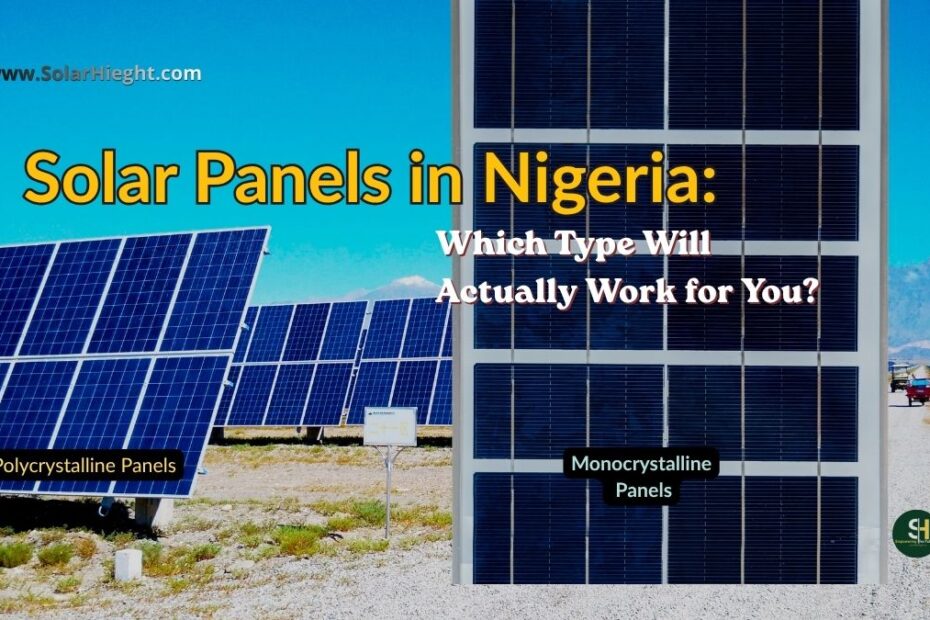
An image of two types of solar panels in Nigeria

 Solar Panels in Nigeria: Which Type Will Actually Work for You?

An educational guide to choosing between Monocrystalline and Polycrystalline solar panels, with your wallet and sanity in mind.

If you live in Nigeria and you are reading this, you already know the struggle. You have probably spent more hours in the dark than you have watching your favourite Nollywood movies. You have poured money into generators that guzzle fuel like a thirsty camel, and you are tired of the noise, the fumes, and the anxiety of “will it start today?”

Solar power sounds like the promised solution. But when you start looking, you are faced with a decision: Monocrystalline or Polycrystalline? These are the two types of Solar Panels.

This is not just a technical jargon test. Choosing wrong can mean the difference between powering your home for 25 years and having an expensive, underperforming slab of glass on your roof within a few years.

This guide cuts through the noise to help you make the right choice for the Nigerian condition.

 The Two Main Contenders

Before we dive in, make sure you’ve read our complete guide on sizing your system correctly—click here

Let’s break down the two dominant types of solar panels available in the market.

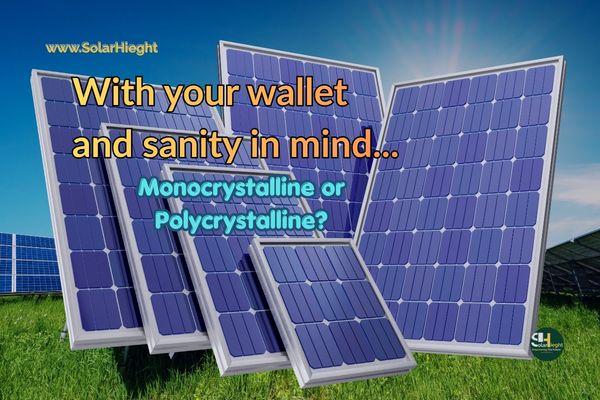
An image of solar panels on display indicating the existence of different panels and the choice Nigerians have in the face of these two main types.

Monocrystalline Panels: The High-Performer

Think of these as the “top shelf” option. They are made from a single, pure silicon crystal, giving them a sleek, uniform black appearance .

  • – Efficiency: They are the most efficient, converting 15% to 23% of sunlight into electricity
  • Lifespan: They have a long lifespan, often exceeding 25 years.
  • Cost: They are generally the more expensive option.

Nigerian Reality Check: Because they produce more power per square metre, monocrystalline panels are ideal if you have limited rooftop space (common in Lagos and other urban areas) but need to generate significant electricity. A study at Ago-Iwoye found that actual weather conditions can reduce panel output significantly compared to manufacturers’ claims . With monocrystalline, you have a better chance of meeting your needs despite these losses.

 Polycrystalline Panels: The Budget-Friendly Workhorse

These are made by melting multiple silicon fragments together. They are easily recognised by their speckled blue colour.

  • – Efficiency: They are less efficient, typically ranging from 13% to 18% .
  • – Lifespan: They have a slightly shorter lifespan of 20-25 years .
  • – Cost: They are more affordable, making them a popular choice for budget-conscious buyers.

Nigerian Reality Check

A study in Nigeria showed that the surface temperature of a polycrystalline panel could be reduced from 49.25°C to 38.38°C with cooling, which increased its efficiency from 13.99% to 15.01% . This is crucial because Nigerian heat is a major efficiency killer.

 The Nigerian Factor

Why “Simple” Buying Doesn’t Work

The choice isn’t just about specs. It’s about surviving the Nigerian environment. Here’s what you need to consider:

 1. The Heat is a Thief

Nigeria’s abundant sunlight is a blessing and a curse. The high solar radiation increases the surface temperature of PV panels well above the optimal 25°C, which reduces their efficiency . This is why a panel that promises 400W might only deliver much less under the scorching sun. Monocrystalline panels often handle heat slightly better than polycrystalline, but both will see a drop in performance .

 2. The Rainy Season “Surprise

The rainy season is a nightmare for unprepared solar owners. Experts at SolarNaija note that during the rainy season, a “haze” of mineral deposits and dust can cut energy output by between 15 and 30 percent . Rain doesn’t clean your panels; it leaves a film that blocks sunlight. Regardless of whether you choose mono or poly, you must commit to cleaning them with a soft cloth and water every few weeks during this period .

 3. The “One-Size-Fits-None” Approach

A solar expert, Yakubu Yunusa, highlighted a common mistake: “Many Nigerians simply copy a neighbour’s solar setup without professional audits, leading to undersized or oversized systems” . He recounted a client who spent ₦1.5 million on a 1KVA off-grid system that drained within hours because it wasn’t designed for their actual appliance load .

 4. The Cost Barrier and the “Substandard” Trap

Solar is expensive. Music producer Somik Chris Ikesom told DW that while solar transformed his studio, “Installing solar these days is not cheap. It runs into millions” . This high cost leads many to seek out cheaper options, which is where the danger lies. [Internal Link to how to grow your solar]The market is flooded with cheap, uncertified batteries and panels that fail within months . This is a huge reason why many solar systems fail, not because the technology is bad, but because of “poor planning, the use of substandard materials, and unqualified workmanship” .

 5. Safety and “Quack” Installers

The desperate rush for solar has created a dangerous situation where installations are outpacing oversight . The Nigerian Electricity Management Services Agency has raised concerns about fire incidents linked to improperly installed solar systems . The panels themselves are rarely the cause; the danger is in “undersized wiring, poorly connected electrical systems, defective charge controllers, and batteries installed without adequate ventilation” . A cheap polycrystalline panel from a reputable brand is a far better investment than a “bargain” monocrystalline panel installed by a quack.

 The Verdict: Which One Should You Buy?

 Choose Monocrystalline If:

  • 1.  You have limited rooftop space in a city like Lagos or Abuja.
  • 2.  You are willing to pay a premium for maximum power generation.
  • 3.  You have the budget to buy high-quality panels from a Tier 1 manufacturer . There are no Tier 1 Nigerian panel manufacturers yet, so you will be buying imported . The government is considering a ban on imports to boost local manufacturing, but for now, careful sourcing is key .

 Choose polycrystalline If:

  • 1.  You have ample space for installation (e.g., a large compound in the suburbs).
  • 2.  You are on a tighter budget and need a cost-effective solution.
  • 3.  You plan to use a proper cooling mechanism (like a hybrid PV-thermal collector) to boost efficiency, which a study has shown can work well with polycrystalline panels in Nigeria .

 Beyond the Panel Type: Your Success Checklist

Before you spend a single kobo, do this:

At the very end, after the final “Do it right” sentence. 

  • 1.  Get a Professional Power Audit: Do not copy your neighbour’s setup! A qualified installer will calculate your exact energy needs. As Yunusa advises, “The problem has never been that solar technology doesn’t work. The real issues are poor planning” .
  • 2.  Buy Quality, Not Price: “Choosing price over quality” is one of the top five errors causing solar failures . Look for international certifications like IEC 61730 for safety and IEC 61701 for durability . A cheap panel will cost you more in the long run.
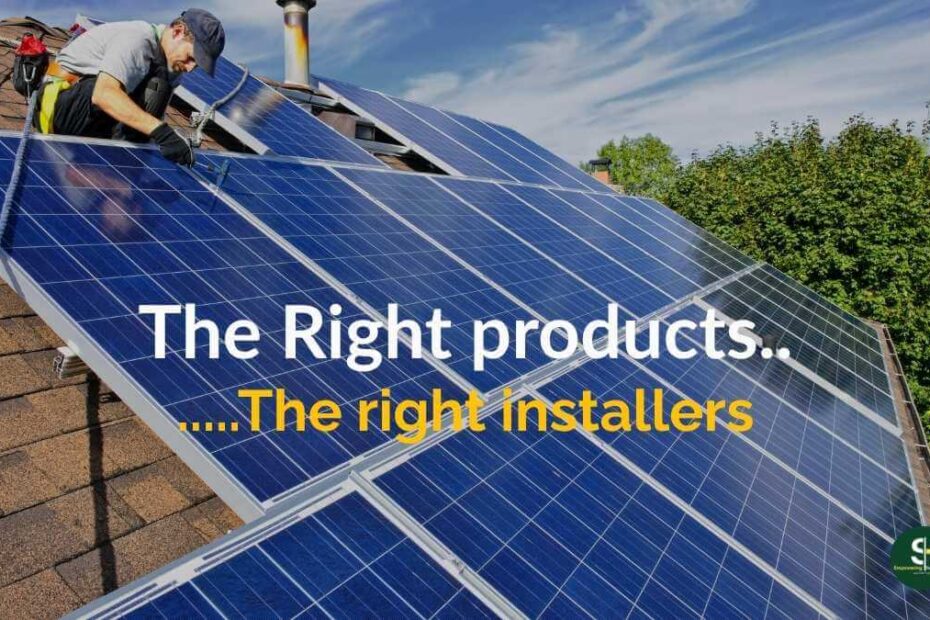
  • 3.  Hire Certified Installers: If you have to ask “how much to install?” you’re not ready. Ask “are you certified?” “Using unqualified installers and DIY shortcuts” is a recipe for disaster .
  • 4.  Maintain Your System: Neglecting maintenance is a guaranteed way to fail. Make sure you get a system that has readily available after-sales support, and clean your panels regularly, especially during the rainy season .

Read our full guide for Nigerian homes here.

In short: For a Nigerian user, the monocrystalline vs. polycrystalline debate is secondary to the primary rule: Do your research, hire a pro, and never sacrifice quality for a lower price. Your solar system is a long-term investment in peace of mind. Do it right, and you’ll be laughing all the way to the bank while your neighbours are still buying fuel.

the great defection why nigeria lost its best custormers

 THE GREAT DEFECTION:Nigeria’s Grid Lost Its Best Customers

By (Obi Amabuo-SolarHieght)– Solar Commentator & Energy Insider

The new wave of defection that just begun again in the Nigerian political parties, had already started in the power sector. If you still believe the Nigerian grid will come back tomorrow, you are no longer an optimist.

You are a liability to your own finances.

While the rest of the world debates energy transition, Nigeria is experiencing a silent, violent, and permanent divorce. The wealthy, the savvy, and the productive are leaving the national grid. And they are never coming back.

This is not a guess. This is math.

In 2025 alone, Nigeria installed 803 megawatts (MW) of new solar capacity. That brought our total to nearly 1.19GW.But here is the statistic that should keep every DISCO manager awake at night: 96% of that new capacity is OFFGRID. Rooftops. Factories. Minigrids. Small businesses. The people who actually pay for electricity have stopped waiting for you. They have built their own power plants. Welcome to the great Defection

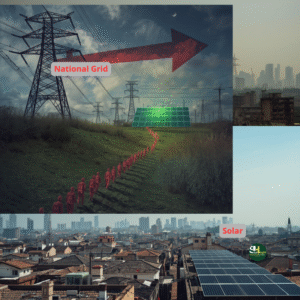
An image of Grid infrastructure and the great movement of people from grid to solar energy dipicting a clear choice
People are indeed moving away from National Grid to Solar Energy

 The Silent Statistics No One Is Talking About

Let me break down what 1.19GW actually means.

1.19GW is roughly 40% of the erratic power the national grid sometimes generates. That 803MW added in 2025 is larger than the entire grid capacity of some West African countries. And the kicker? The grid is actually shrinking in terms of paying customers.

Every week, three things happen:

1. A wealthy household in Lekki spends ₦3–4M on a solar system and disconnects from the grid permanently.

2. A small business owner in Aba installs solar for their factory and stops paying DISCO tariffs.

3. A rural community switches on a minigrid and never looks back.

The utility is left with the poor, the desperate, and the disconnected.

 The Death Spiral Has Already Begun

Here is the painful cycle that no government official wants to admit in public.

No.1: High paying customers (industries, SMEs) defect to solar.

No. 2: The DISCO loses its best revenue source.

No. 3: To cover fixed costs, the DISCO raises tariffs on remaining customers.

No. 4: Those remaining customers (already struggling) can no longer afford the higher tariffs.

No. 5: They also defect—or simply stop paying.

This is called the Utility Death Spiral.

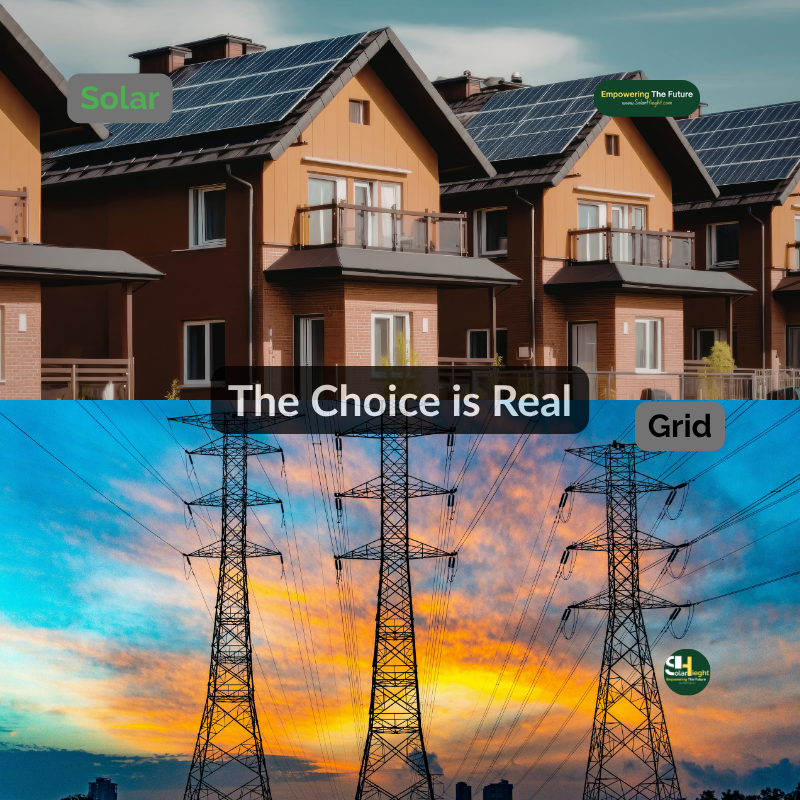
The image of solar installations on a residential rooftops against a fading imaging of a national grid signifying the energy choice people are making

And Nigeria is already spinning.

Realtime example: In Lagos, DISCOs now rely on estimated billing for over 60% of their residential revenue. Why? Because if they installed actual meters, customers would see how little power they actually receive, take other measures, refuse to pay, and defect to solar even faster. The utility is trapped. And they know it.

 What Happens Next? 3 Predictions for 2026–2030

 Prediction 1: Hybridization Becomes Mandatory (The Grid as Backup)

By Q2 2027, no new business in Lagos, Abuja, or Port Harcourt will open without a solar hybrid system. Not because of regulations, but because of survival. The grid will not disappear, but its role will change forever. It will become a glorified backup generator—expensive, unreliable, and only used when the batteries run dry.

What this means for you:  If you are building a new house or business and you do not budget for solar, you are building a liability, not an asset.

 Prediction 2: The Local Manufacturing Boom (Price Stabilization)

Right now, we are bleeding foreign exchange on every solar panel imported. A 550W panel that cost ₦80,000 in 2024 now costs over ₦250,000. But the tide is turning. The $750 million DARES program is not just a talking point. It is funding local assembly plants. By Q4 2026, we will see the first major price drop as locally assembled panels enter the market.

What this means for you:   If you can afford to buy solar today, do it. But if you are on a tight budget, wait until early 2027. Local assembly will crash prices by at least 30–40%.

 Prediction 3: The End of Diesel Logistics

Let me say this clearly: The diesel generator industry is dying. It will not disappear overnight. But every new solar installation is a nail in its coffin. By 2028, the only people running generators 24/7 will be those too poor to afford solar- a tragic irony.

If you are an investor holding diesel distribution assets, sell them now. The secondary market for generators is already flooded with cheap fairly used units. That is a dead market walking.

 Investor Advice: Where to Put Your Money (And Where to Run From)

I talk to investors every week who want to get into solar. Most of them are looking in the wrong places.

Here is where you should and should not invest.

  Stop Investing In:

 Hardware retail (solar shops): Margins are crushed by FX volatility.

 Diesel logistics: Read the room. The obituary is already written.

 Standalone gridtied inverters (no battery): Useless when the grid collapses at 7pm.

 Start Investing In:

 1. SolarasaService (Leasing/Subscription)

SMEs do not want to spend ₦5M upfront. They want to pay ₦150,000 monthly for five years.

Companies leading this: Victron Energy, Earthbond, Arnergy, Rensource.

Why it works: You earn recurring revenue (OPEX), not onetime sales (CAPEX). The customer wins, you win, and the cash flow is predictable.

Investor action: Back asset financing companies, not installers. The money is in the financing, not the hardware.

 2. Cold Storage & AgroProcessing (Productive Use Solar)

The biggest ROI in Nigerian solar is NOT selling electricity to homes.

It is selling electricity to businesses that make money from power.

Examples:

 Solarpowered cold rooms for tomato sellers (reduces postharvest loss from 60% to 5%).

 Solar mills for rice and cassava (replaces expensive diesel mills).

 Solar irrigation for dryseason farming (turns unused land into cash flow).

Why it works: A homeowner saves ₦50,000/month on fuel. A cold room owner earns an extra ₦500,000/month in preserved goods. Which is the better investment?

Investor action: Partner with agricultural cooperatives. Offer leasetoown cold rooms. The repayment rates are higher than residential solar because the income is provable.

 What Solar Users & Enthusiasts Must Do Now

If you are a homeowner, a renter, or someone who just wants light and AC, here is your honest action plan.

 1. Stop Waiting for the Grid to Improve

The grid is not going to be fixed in 2026. Or 2027. Or 2028.

The transmission infrastructure requires billions of dollars and years of political will. Neither is coming soon.

Your job: Treat solar as your primary power source. Treat the grid as a free bonus if it shows up.

 2. Buy Lithium, Not Tubular Batteries

Yes, lithium batteries are expensive upfront (₦1.5–3M for a good 5kWh system).

But here is the truth:

 Tubular batteries need distilled water monthly, release hydrogen gas (dangerous indoors), and last 3–5 years.

 Lithium batteries are sealed, maintenancefree, last 8–10 years, and have builtin battery management systems (BMS) that prevent overcharging and fires.

A lithium system costs more today. But it is cheaper over 10 years. Do the math.

 3. Buy Now If You Can Afford It

Prices are not coming down until the Naira stabilizes or local manufacturing ramps up (late 2026 or early 2027).

If you have the money today, buy today. Every month you wait with a generator, you burn that money in fuel.

If you cannot afford a full system today, start small:

 A solar generator (2.5kW/2kWh) for ₦800k–1.2M.

 Add panels gradually.

 Add more batteries later.

Do not let perfection be the enemy of progress. Intimate yourself of the current trends

An image of time and a meter depicting the urgent need to make a decision
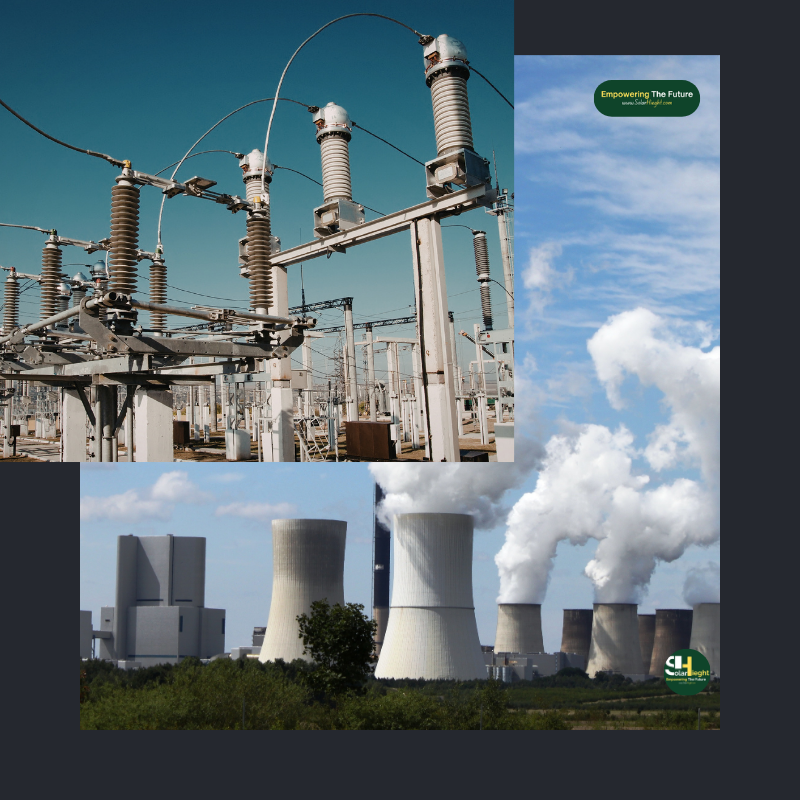
Two images of  energy infrastructure, one of a transmission and the other of source.

 The Final Verdict: What Does This Mean for Nigeria?

The Great Defection is not a crisis. It is an opportunity.

Yes, the utility will struggle. Yes, tariffs will rise for the poor. That is the painful truth.

But here is the bigger truth:

Nigeria is building a decentralized, resilient, independent power system—one rooftop at a time.

By 2030, I predict:

 Over 5GW of distributed solar across rooftops, minigrids, and C&I sites.

 At least 3 major local assembly plants producing panels and batteries.

 A generation of Nigerian engineers and installers who are worldclass.

The grid is dying. But Nigerian energy is being reborn.

The question is not whether you will go solar.

The question is whether you will be early—or left behind.

 Your Next Step (No Sales Pitch, Just Advice)

If you are ready to explore solar for your home or business:

1. Get at least three quotes from verified installers (ask for previous projects).

2. Demand lithium batteries with a minimum 5year warranty.

3. Ask about lease or subscription options if upfront cost is a barrier.

And if you want to stay ahead of every trend, every price shift, and every industry scandal?

Follow this page. Share this post. And let’s build a solar Nigeria together.

SolarNigeria TheGreatDefection RenewableEnergy InvestInSolar OffGridLiving NigerianEnergy

Want a downloadable PDF checklist: 10 Questions to Ask Before Buying Solar in Nigeria 2026? Drop a comment or send a DM.

Rooftop solar panels under bright sunlight — dipicting Nigeria’s slow but hopeful shift toward clean energy

Why Most Nigerians Still Fear Solar-A Practical Guide to Get Started Safely

Nigeria: A Country Full of Sun, But Not Yet Solar

Rooftop solar panels under bright sunlight — dipicting Nigeria’s slow but hopeful shift toward clean energy
Rooftop solar panels on Lagos business district — a bright promise still shadowed by public doubt and misinformation

Nigeria enjoys one of the best sunlight levels in Africa, yet solar adoption remains surprisingly low. The irony is painful:in a country where the national grid provides barely 4 hours of power daily, millions still hesitate to switch to solar.This post explores the roots of that fear, shares real Nigerian stories, and offers practical ways to rebuild trust — whether you are a homeowner, trader, or simply curious about clean energy, this post is for you.

The Daily Power Struggles

From Lagos to Enugu, Abuja to Aba, Nigerians wake up each day unsure whether the light will stay on.

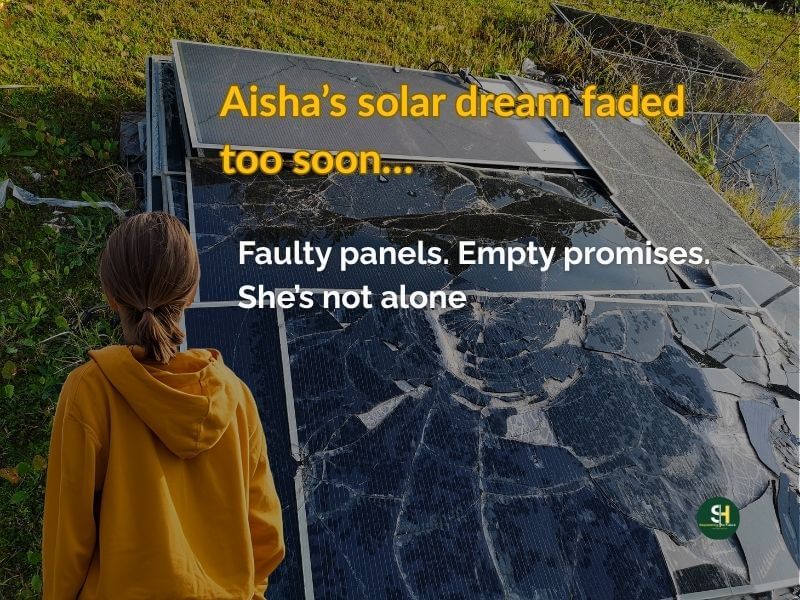
Mrs. Aisha, a small-shop owner in Lagos, once invested ₦3 million in a solar setup. Her installer vanished weeks later, leaving her with dead batteries and no refund.

“I fear solar more than NEPA failure,” she sighs. Her story is far from unique. Many others share the same heartbreak. Yet some more are fed up with the erratic *kpo-kpo-kpo”of the generator, the endless expense of diesel, and the sudden silence when “NEPA takes the light.” They know solar energy is a sustainable, long-term solution. They have even seen their neighbour’s panels gleaming in the sun.

  • But then, the doubts creep in.
  • Is it not too expensive?
  • What if they sell me fake products?
  • Will it even work during the rainy season?

If this sounds familiar, you are not alone. Many Nigerians are hesitant to take the solar leap, not because they don’t want to, but because real fears are holding them back.The fear of solar isn’t about sunlight — it’s about trust, quality, and access. Downloaded our Free Solar Kit Checklist here for more information about your solar journey.

What Fuels the Fear of Solar?

1. High Upfront Costs and Scams

A decent home system costs around ₦2.5 – ₦3 million. Add fake installers who collect cash and disappear, and you get lasting distrust. This is the number one barrier. A solar system requires a significant initial investment, and when compared to the piecemeal cost of buying fuel, it can feel overwhelming if you have not seen our blog on this.

This is deep-seated and here is why: We are wired to feel the pain of a large, immediate payment more acutely than smaller, recurring ones. We see the N2.5 million price tag for a solar system but don’t easily calculate the N80,000 we spend “every single month” on fuel, maintenance, and replacement parts for a generator over 3-4 years.

2. Poor-Quality Products

This is a massive issue in the Nigerian market. Early buyers often ended up with low-grade kits or counterfeit inverters. When they failed, entire neighbourhoods declared solar a waste. This happens with most trends in Nigeria. And that is why, in SolarHieght, we advise that it is better to learn before you buy. Stories are rife of installers who vanish after receiving payment, leaving customers with a useless box of electronics.

The market is saturated with opportunists. This erodes trust for everyone, making it hard for legitimate companies to be believed. The fear of being scammed out of a huge investment is paralysing.

3. Lack of Skilled Technicians And Complex Technical Terms

Across both cities and villages, trained technicians remain scarce. Wrong wiring and poor maintenance lead to quick system failures. According to Reuters “In Nigeria, practical skills training is practically absent in colleges” bridging this skills gap could impact the solar sector greatly.

In the other hand, terms like inverters, charge controllers, kilowatt-hours, and amp-hours can sound like a foreign language. This complexity makes the process feel intimidating and opaque.People fear what they don’t understand. Without a clear, simple explanation, it is easy to feel like you are at the mercy of a salesperson and can’t make an informed decision.

4. Lack of Government Support & Unclear Regulations

While this is changing, there’s a perception that there’s no safety net or regulatory framework for solar energy, unlike the (theoretical) structure provided by DISCOs. Big projects stall; homeowners face failures alone. Manufacturer’s Warranties becomes useless in the face of lack of strong consumer protection policy. And as a result, the market becomes a gamble. We are accustomed to systems failing due to poor policy. The fear is that the government won’t support the industry, leading to a lack of standards or consumer protection.

In Germany as in many other countries, the Renewable Energy Sources Act (EEG) is a bill that ensures consumers are protected in this industry. Zero VAT on solar materials for upward of 30 years are some of the Tax benefits covered by the bill. More so, there is the KFW loans and regional grants offered by regional governments as part of the protections that consumers enjoy. In addition, companies that sale and offer solar related services have very strong warranties attached to all their products which not only boost confidence but also protect consumers. It is important to note that the updated environment that changes to the EEG bill adopted in the recent past, has made the Consumer and citizen energy communities grow even stronger.

5.Reliability

What Happens When the Sun Doesn’t Shine?

The Nigerian sun is powerful, but it is not constant. The long rainy season and dusty harmattan conditions lead to a very valid question: will I be left in the dark?We have been let down by unreliable power sources for decades. The fear of investing in another system that might fail us when we need it most—at night, during a cloudy Knight—is a major psychological block.

Real Stories That Break the Fear

The Sabon Gari Market Mini-Grid (Kano)

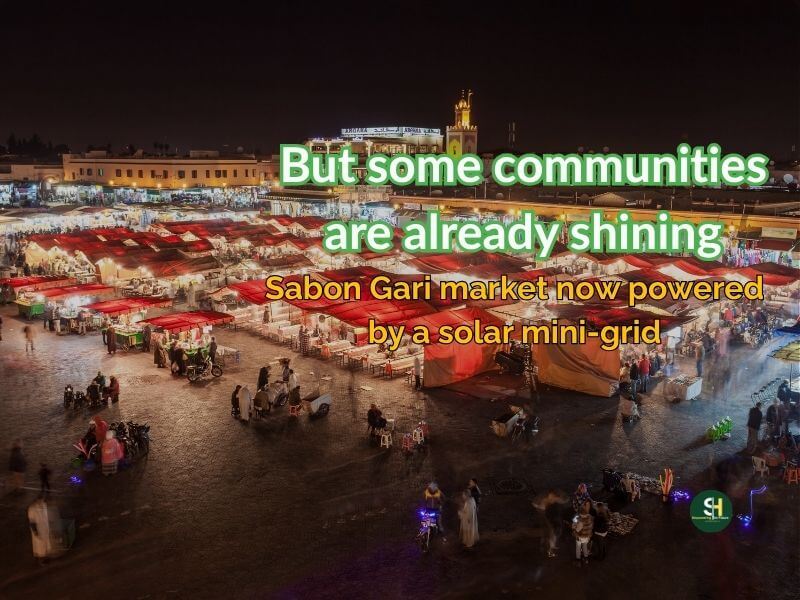
For years, traders in the Sabon Gari Market relied on diesel to power their systems and business as a measure to forestall the epileptic nature of the national grid. The consequences-unbearable noise pollution, exhausting effects of carbon dioxide emission and th suffocating effects of the both mentioned above became unbearable. Working through The Rural Electrification Agency, the Nigerian government partnered with Victron Energy to build a smart solar solution that transformed the life of traders at the Sabon Gari Market. That effort saw the birth of a solar mini-grid that instantly transformed over 160 shops. The mini grid was structured to allow for growth and optimisation in the energy capacity of the mini solar infrastructure. In one of my posts on SolarHieght, I emphasised that smart energy solutions are achievable through structuring solar systems in a ways that allow growth and optimisation as energy need grows. This is a good example of that. The Mini Grid Structure was built in a way that energy capacities can be scaled by adding additional parts to the old ones. For instance, adding a few more panels, inverters etc, that takes care of the increasing or growing energy needs without loosing any part of the energy infrastructure. You can also adopt this strategy. With the new solar infrastructure the traders in Sabon Gari market are, in many ways improving their productivity, while at the same time reducing noise pollution that was the bane of the pre-mini Grid Era.

“It’s like moving from hell to heaven,” says Musa, a shoe seller at the market who survived the pre-grid era and is now enjoying the post-grid era. Now he can confidently point out to quite a few differences between the two eras.

Arnergy & Husk Power’s Pay-As-You-Go Model

The above is modeled after the Mobile phone system, the Arnergy & Husk´s Pay as You Go (PAYG) is leveraging smart solutions to offer users the possibility of accessing solar energy by paying ₦500 – ₦1 000 daily via mobile money. Systems come installed, monitored, and serviced. Low income households could now charge their phones. This way you don’t need to own an entire solar system to be able to use basic energy needs. A few thousands could help you stay connected and do other things that you would have not been able to do without these developments.
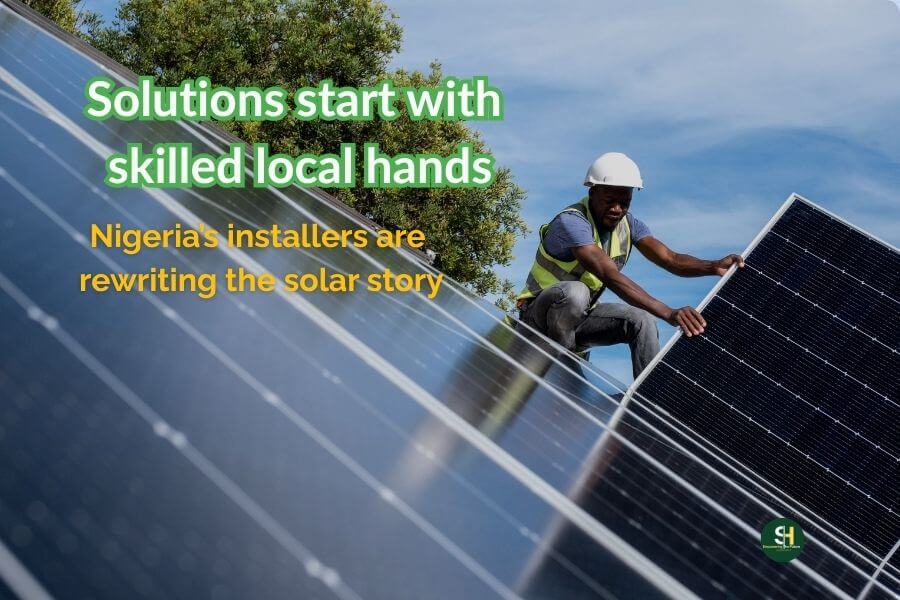
Young Nigerians are becoming certified “energy officers,” building local trust and new jobs.
AP News — Solar Jobs in Nigeria

How to Adopt Solar Energy with Confidence

Beating the Cost Fear: Smart Financing & The True Cost of Ownership

The first step would be to shift mindset from “initial cost” to “long-term value”. This is the key because there is no doubt that the initial investment in solar in comparison to the monthly costs of NEPA and diesel (for those who combine NEPA with generator) shows a great difference in cost. A more smart approach would focus on the long term costs of both which indicates, very clearly, how the initial investments in solar systems palls tremendously in comparison to the cost of NEPA bill and diesel for say 10 year period.

Explore Phased Implementation:

You don’t have to power your entire house at once. Start with a “Solar Essential” system that runs your lights, fans, TVs, and sockets.Check the right sizing and battery basics. Later, you can expand to include heavy loads like air conditioners.In doing so, check available financing options because some reputable companies now offer payment plans. If this exists in your area, ask what options are available, scale with anyone that appeals to you and negotiate with them on how the costs can be spread over time. Below is a video from our Youtube channel showing how one can start with small and grow with time without having to lose any of your investments. You can also check our solar kit to see how you can build your solar system step by step. You must not break a bank to do so.

The Critical Role of a Professional Audit:

A trustworthy installer will not just give you a price. They will conduct an “energy audit” to list all your appliances, their power consumption, and how long you use them. This data is used to “right-size” your system, ensuring it can handle your needs. The concept that Battery is King is derived from the Reliability question that must be answered in choosing your battery type.The panels collect energy, but the batteries store it for use at night or on cloudy days. Therefore, investing in quality batteries (good tubular gel or lithium-ion) with a long lifespan is crucial. Don’t cut corners here. https://solarhieght.com/solar-projects-fail-nigeria/

Avoid Scams: Adopt the 5-Step Vetting Process for Solar Installers

This is your most powerful tool. Do not skip these steps.

1. Demand Verifiable References: Ask for contact details of at least two past clients in your area. A legitimate company will be proud to connect you.

2.  Check for a Physical Address & Track Record: Visit their office. How long have they been in business? A company with a physical presence is less likely to disappear.

3. Scrutinize the Quotation: A vague quote is a red flag. The quote must itemise brands and models for “every” component (Panels, Inverter, Batteries, etc.). This allows you to research the quality of the products.

4.  Ask About the Warranty:There should be two warranties: a manufacturer’s warranty on the parts (e.g., 25 years on panels, 5 years on inverters) and a “workmanship warranty” on the installation itself (e.g., 1-2 years).

5.  “Check Their Digital Footprint:” Look for reviews on Google, Facebook, and other platforms. A complete absence of an online history is a warning sign.

Demystifying the Tech:

A Simple Guide to Key Components of the solar energy systems would help to adopt solar energy with confidence. You need not be an expert but understanding these components will save you a hell of troubles. So let’s demystify this. Think of your solar system like a human body: The Solar Panels is the “Muscles”. They capture the sun’s energy. The Inverter is the Brain & Heart. It converts the energy from the sun into usable power for your home and manages the entire system. In the vain, think of the Batteries as the Fuel Tank. They store energy for when you need it. There is the Charge Controller: This is the Regulator that protects your batteries from overcharging.

Like I said before, you don’t need to be an expert or engineer, but knowing these basic concepts empowers you to have an intelligent conversation with any installer.

Why Solar Still Wins in the Long Run

  • Reliability: Solar systems with batteries deliver more consistent power than the grid.
  • Savings: Less spending on diesel generators over time.
  • Health & Environment: No fumes or noise from generators.
  • Jobs: Solar creates local employment—installers, technicians, sales agents.

Community Impact: Schools and clinics stay lit for longer hours. Women and students benefit especially (CLG Global, Reddit, Wikipedia, Reuters,

Conclusion: Don’t Fear the Sun — Own It

Solar energy isn’t the enemy; it is the escape route from darkness. The fear came from poor products and bad experiences. The transition to solar isn’t just about technology; it is about making a smart, informed financial decision for long-term peace and independence. The fears are real, but they are beatable with the right knowledge and leveraging on new financing models, certified technicians, and transparent companies that are now abound in the solar energy space..

At SolarHieght, we believe in transparency, quality, and building trust. We tackle these fears every day by providing you with simple solar energy facts, smart solutions, detailed audits procedures, how to identify only tier-one components, guides to robust warranties, and guiding you every step of the way. If you have had any doubts towards going green or find any solution not mentioned above but advances the interests and engagement in solar, please do not hesitate to contact us.

Frequently Asked Questions (FAQ)

Q: How much does a solar system for a 3-bedroom flat in Lagos cost? 

A: ✅ It depends entirely on your energy needs. A basic system powering lights, fans, TV, and a fridge might start around N1.2 million. A full system that can also power 1-2 air conditioners could range from N2.5 – N4 million. The only way to get an accurate price is through a professional energy audit.

Q: Can solar power an air conditioner?

A: ✅ Absolutely! The key is to design a system with enough panels and battery storage to handle the high startup and running power of an AC unit. This is a standard request we handle.

Q: What is the lifespan of solar panels in Nigeria’s harsh weather?

A: ✅ High-quality panels are built to withstand harsh conditions, including rain, heat, and even hail. They typically come with a 25-year performance warranty, guaranteeing they will still produce at least 80% of their original capacity after 25 years.

Q: How do I maintain my solar system?

A: ✅ Maintenance is minimal. The main task is periodically cleaning the panels from dust and dirt to ensure maximum efficiency. The inverter and batteries require no regular maintenance from you if installed correctly.

Q: What if I can’t afford a full system?

A: ✅ Start small. A ₦80 000–₦150 000 kit can power fans and lights; scale later.

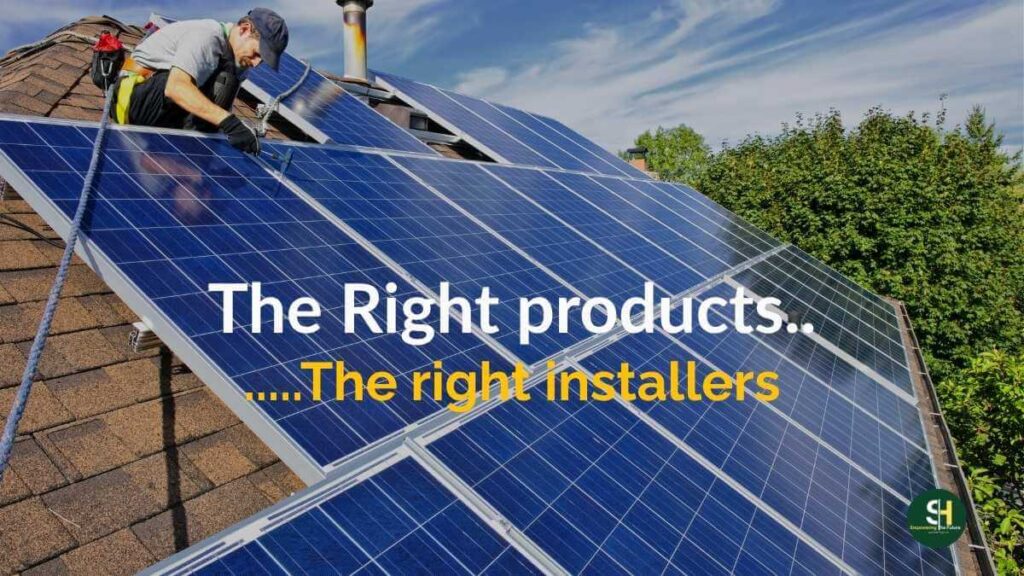
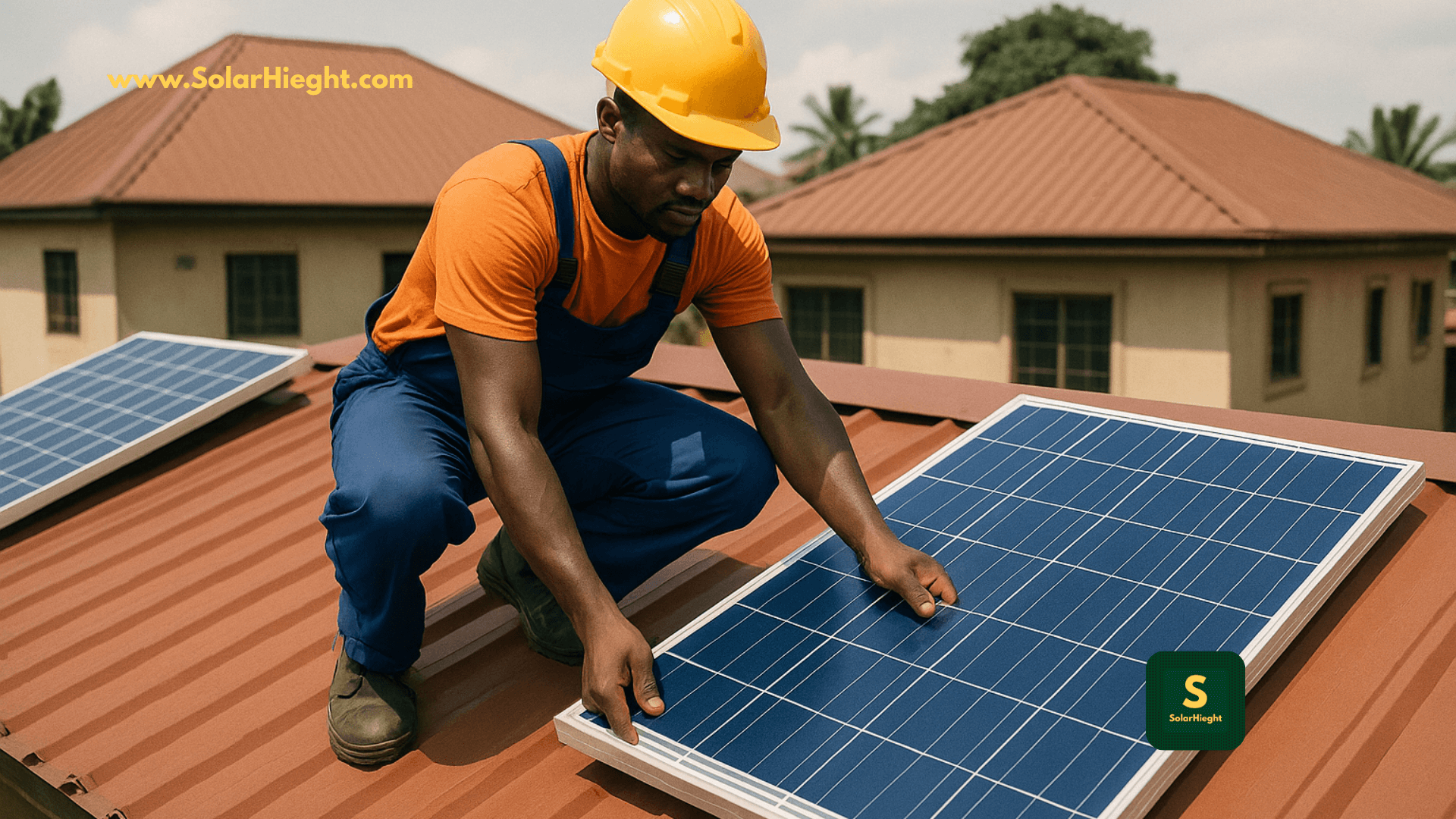
solarhieght blog featured image for the blog post the real reason solar projects fail in nigeria a professional installer working on top of a solar rooftop

Why Solar Projects Fail in Nigeria — and How to Fix It

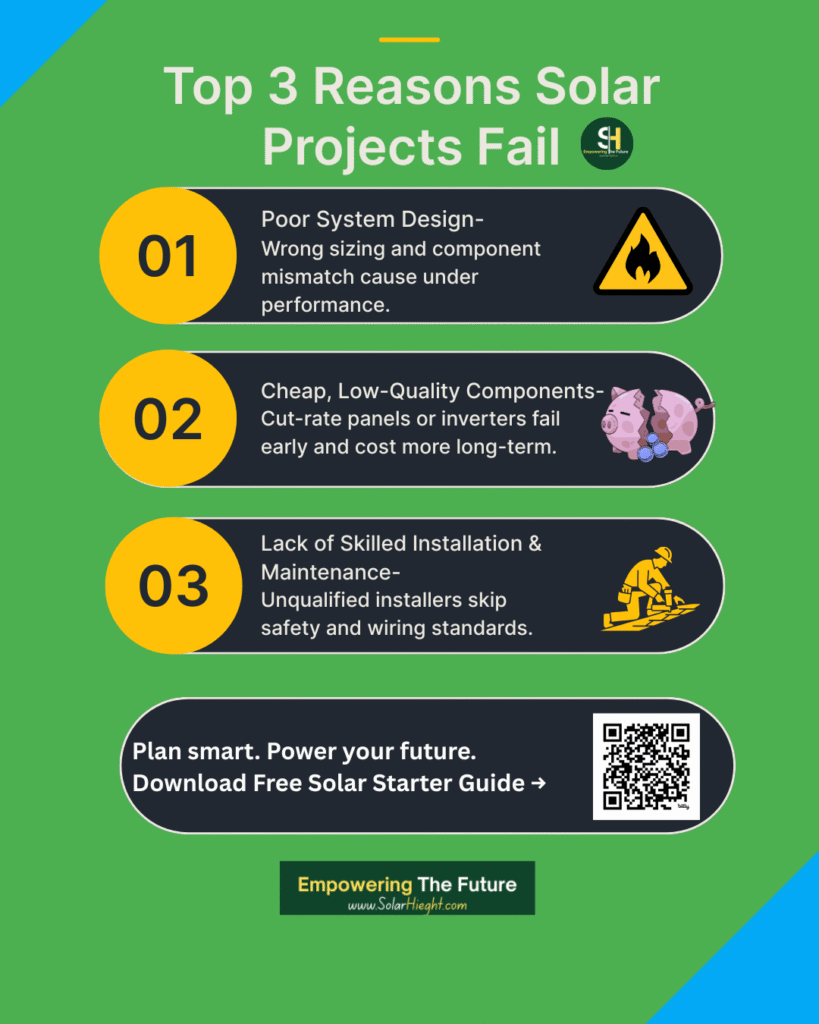
The Real Reason Solar Projects Fail in Nigeria — And How You Can Avoid It


Introduction: The Story Behind the Failure

Last year, a friend called me in frustration.

“My ₦500,000 solar system has stopped working again!”

It wasn’t the sun’s fault — it was human error. Across Nigeria, thousands of homes face the same heartbreak: solar installations that promise freedom but collapse within months.
So, why do solar projects fail so often, and how can you avoid the same fate?


The Hidden Problem Nobody Talks About

Most failures begin before installation — with wrong information.
People buy panels or batteries because a friend said “it works for me,” not because it matches their actual power needs. Identifying energy needs is as important as investing in Solar energy. I have done justcie to this matter on  How to Choose the Right Solar Kit for Your Nigerian Home and the The Guardian Nigeria — Fake Solar Products Report gave some insight on the veracity of the problem.


1. Mistake — Wrong System Design

  • Load not calculated properly.
  • Batteries undersized.
  • Inverters chosen by price instead of rating.

Before you buy anything, calculate your wattage and daily usage.
This is, most often, the first mistake that people make. Not researching a bit about solar project and how they should approach their energy needs is a crucial mistake.. Many would rather depend on just what they are told by some unprofessional volunteers rather than rely on some well researched book or presentation or even a solar calculator.


2. Mistake — Poor Installation & Zero After-Sales Care

A neat wiring job is not enough.
Ask your installer:

  • Do you test voltage drops?
  • What’s your warranty policy?
  • Do you teach basic maintenance?

For starters, you should Download our Free Solar Kit Checklist here. It will give you an insight on how to approach any solar investments you decide to make.


3. Mistake — Neglect and No Maintenance Routine

Solar panels love attention.
A simple cleaning every two weeks can raise performance by 10–15%.
Don’t ignore battery water levels or surge protection.

Personal Touch:

“At SolarHieght, I have learned that most failures come from neglect, not the panels themselves.”


The Right Approach — Build Smart, Start Small

Start with a small, well-designed system and expand gradually.
Research component compatibility, use trusted brands, and always insist on documentation.

It would be important to take a cursory look at IRENA — Renewable Energy in Africa for expert knowledge about what you should expect before ordering those first solar products.


Conclusion + CTA

A good solar project doesn’t end at installation — it begins there.
With the right knowledge and small, consistent care, your solar system can last years without stress.

Download your free Solar Kit Checklist and learn how to build smarter.

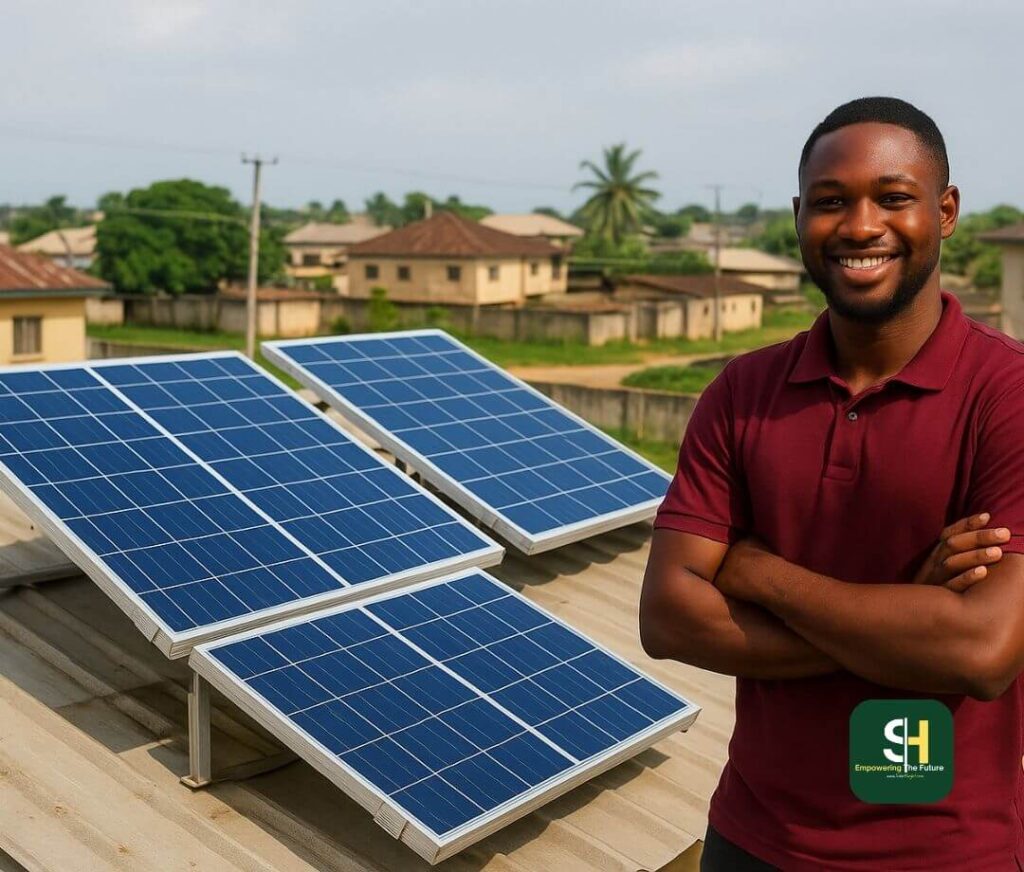
Nigerian man smiling beside rooftop solar panels in a residential area.

How to Start Small with Solar in Nigeria -And Expand Later Without Wasting Money.

Start Smart, Not Big

Solar energy can transform your home—but in Nigeria, many are still afraid of switching to solar. Why?

Because they think it’s too expensive and only for the rich. Because they’ve seen neighbors buy “complete kits” whose initial investments seem to be beyond the roof or they have seen one such investment that failed not long after it was installed. Because installers offer no real plan—just a price.

But you don’t have to go big all at once. In fact, the smartest solar journeys are those that start small, with expansion in mind. Let’s show you how to do just that.

Nigerian man smiling beside rooftop solar panels in a residential area.
Starting small with rooftop solar can save money and provide reliable power.

Why Many Nigerians Still Fear Solar

It’s not just the price. People fear solar because:

  • They’ve seen fake or mismatched products
  • Installers give them wrong or exaggerated promises
  • They try to power the entire house from Day 1
  • They don’t know what they really need

Let’s remove the fear and start from what matters most to your home today.


Plan 1: The Basic Essentials Kit (₦180,000–₦250,000)

The Basic Essentials Kit (₦180,000–₦250,000)

This is a starter kit that can power:

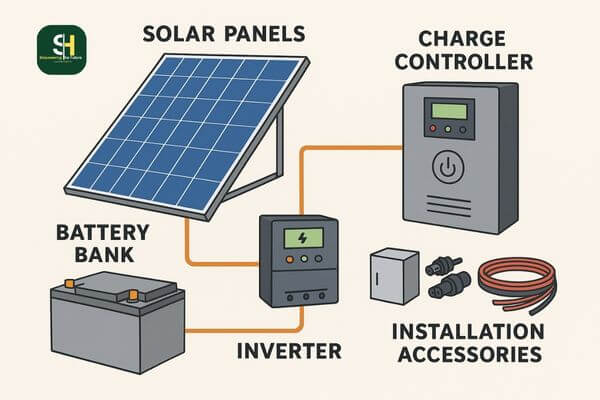
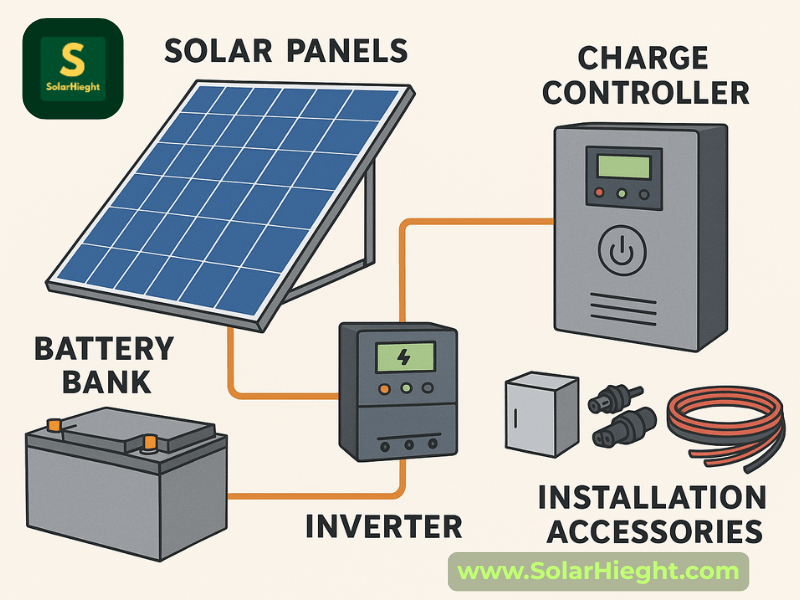
Diagram of solar panel system with inverter, battery bank, charge controller, and accessories.

✅ 3–5 energy-saving bulbs

✅ 2 charging ports

✅ 1 standing or ceiling fan

✅ 1 small LED TV

If you think this wont make any difference, experience, like I did years back in Iyakari Estate, Lagos. Several days of NEPA outages that forces people to sleep in balconies and hear a thousand rhythms of mosquito songs. The above kit can still keep you inside the mosquito-net-covered comfort of your room enjoying your TV and your fan.

Suggested Kit Components

ComponentQuantitySpecs (Minimum)
Solar Panel1200W–300W
Battery112V 100Ah (gel or lithium)
Inverter1500W–800W (Pure sine wave)
Charge Controller120A MPPT recommended
Cables & AccessoriesBreakers, connectors, etc.

Note: Choose modular components so you can add a second panel or battery later without changing the whole system.


How to Install for Expansion

If you plan smart, you can scale later without throwing money away.

Installation Tips:

  • Use a solar combiner box that allows more panels later
  • Mount your inverter and controller in a ventilated space with space for upgrades
  • Keep wiring neat and expandable—ask the installer to “leave room” for 2–3 more panels or batteries
  • Choose a hybrid inverter if you plan to mix with NEPA or generator in the future

Plan 2: Add a Small Fridge & More Appliances (₦300,000–₦500,000)

Once your basic kit is running well, you can plan for:

  • ✅ 1 small fridge (100–150L)
  • ✅ 2–3 fans
  • ✅ 1 laptop
  • ✅ Lighting backup for more rooms

Additional Kit Requirements

ComponentQuantityNew Total
Solar Panels+1400–600W total
Battery+112V 200Ah total
InverterUpgrade1.5kVA – 2kVA
Charge ControllerUpgrade30A MPPT preferred

✅ Pro Tip: Ask for batteries that can be paralleled easily, like lithium or sealed gel with fuse protection.


Quality Over Quantity: How to Avoid Wasting Money

Don’t just ask “how many watts?”—ask “which brand, which warranty, and how will I expand later?”

What to Avoid:

  • ❌ Panels with no serial number or datasheet
  • ❌ Fake lithium batteries with no capacity label
  • ❌ Inverters that “whine” or overload with small appliances
  • ❌ Mixing brands blindly (especially batteries)

Recommended Brands (Affordable & Reliable)

ComponentBudget BrandsPremium Brands
PanelRitar, Felicity SolarCanadian Solar, Jinko
BatteryBBOXX, MercuryBlueNova, Simba Lithium
InverterMust, SukamVictron, Growatt
ControllerEpever, FangpusunRenogy, Victron

Sample Kits by Budget

Budget (₦)PlanWhat It Powers
₦180,000Plan 1Bulbs, Fan, TV, Phone
₦300,000Plan 2 LiteAdd Laptop, Bigger Fan
₦500,000Plan 2 FullAdd Fridge, 2–3 Fans, Stable Charging
₦800,000+Plan 3Full 2-Bedroom Essentials + Night Backup

We’ll soon provide a free downloadable PDF checklist and an interactive calculator to help you choose the right plan.


Final Word: Solar is a Journey

Start with what you need most—power for your evening comfort, safety, and basic appliances. Then scale gradually.

A ₦180k plan today could grow into a ₦500k hybrid system next year, without wasting a kobo.

Want help choosing your starter kit?

Drop a comment, DM us, or visit our SolarHieght Starter Series for more guides.


Choosing the right solar kit for Nigerian home

Power cuts are real. But the wrong solar kit can make things worse. This post breaks down how to choose the right-sized kit for your needs — from basic lighting to full home setups.

A friend of mine, Julius, was completely fed up with the constant NEPA wahala in Lagos. Tired of blackouts and generator noise, he decided to try solar after hearing about the promise of clean energy. But like many first-timers, he didn’t realize that going solar is only half the battle — choosing the right kit is just as critical. Unfortunately, he picked the wrong components, and within a few months, his entire system stopped producing power.

Power cuts are real. But the wrong solar kit can make things worse. This post breaks down how to choose the right-sized kit for your needs — from basic lighting to full home setups.

Why Solar Power is a Game-Changer

Solar energy provides clean, renewable electricity—without the noise, fumes, or fuel costs of generators. In Lagos and most cities in Nigeria, each time NEPA takes its light, the noise that comes from peoples generators especially at nights,for most people, is almost unbearable.But imagine when that noise is taken away, by an alternative energy source that powers your house and probably that of your neighbours the same way as NEPA but without the unbearable generators noise. In addition to that, solar energy reduces your energy bills and frees you from unreliable grid power. Today’s solar kits are more efficient and affordable than ever, making them ideal for both urban and rural homes in Nigeria.


Understanding Solar Power Systems

Components of a Solar Kit

Before buying a solar kit, it helps to know the main components involved:

Solar Panels – Capture sunlight and convert it into electricity.
Inverter – Converts DC (direct current) to AC (alternating current) used in your home.
Battery Bank – Stores excess energy for nighttime or cloudy days.
Installation Accessories – Includes wiring, fuses, and mounting kits.
Charge Controller – Manages the power flow from the panels to the battery.
#basic-solar-kit-components-for-nigerian-homes

Off-Grid vs. Hybrid vs. Grid-Tied Systems

  • Off-grid systems are self-sufficient and ideal for rural areas without access to the national grid.
  • Hybrid systems combine solar power with grid or generator backup, offering flexibility.
  • Grid-tied systems feed excess power into the grid but are less common in Nigeria due to unreliable infrastructure.

Assessing Your Home’s Energy Needs

Calculating Your Daily Energy Consumption

Start by listing your appliances, their power ratings (watts), and estimated daily usage.

ApplianceWattageHours/DayDaily Usage (Wh)
TV100W5 hrs500Wh
Fridge150W24 hrs3600Wh
Lighting60W6 hrs360Wh
Total4460Wh

This total gives you a realistic idea of the system size you’ll need.

Identifying Power-Hungry Appliances

Some appliances, like air conditioners and water heaters, consume a lot of power. You can either size your system to accommodate them or replace them with energy-efficient alternatives.


Factors to Consider When Choosing a Solar Kit

Power Rating and Battery Capacity

Always size your system slightly above your needs to account for inefficiencies and future expansion.

Quality of Components

Look for:

Tier-1 solar panels
Pure sine wave inverters
Lithium-ion batteries (for durability and lifespan)

Scalability and Expansion Options

Choose a kit that allows you to add more panels or batteries as your power needs grow.This is very core to my previous “How to Start Small with Solar in Nigeria (And Expand Later Without Wasting Money)” Even when you start with the smallest unit, have it at the back of your mind to choose items that allows your system to grow. That way you wont be throwing away any money.Treat the solar experience as  “a marathon and not a 100 meter dash”. That way you will get the best out it without wasting money.


Solar Panel Types and Their Efficiency

Monocrystalline vs. Polycrystalline Panels

  • Which Type Suits Nigerian Weather Best?.
  • Polycrystalline panels are cheaper but slightly less efficient
Visual comparison between monocrystalline and polycrystalline solar panels

☀️Monocrystalline panels

High-efficiency, sleek-looking panels that work well in all weather and last longer. Ideal if you want top performance and durability.
Color: Dark blue or black
☀️ High Efficiency and compact,
————————————
Performs better in low light
🖤 Darker color
Premium design
⚡️ Long-term value

More affordable, slightly less efficient, and great for large roofs. A good choice if budget is a major factor.
Color: Blue or light gray
🌤 Lower Cost
——————————–
Less efficient
Needs more space
🔷 Bluish tint
Budget-friendly
💸 Affordable starter option


Battery Storage Options for Nigerian Homes

Lead-Acid vs. Lithium-Ion Batteries

  • Lead-acid batteries: Affordable but bulky, with more maintenance needs.
  • Lithium-ion batteries: Longer lifespan, faster charging, and compact design.

Runtime and Depth of Discharge (DoD)

Higher DoD means more usable energy. Lithium batteries usually offer 80–90% DoD, making them more efficient.


Inverter Selection and Its Importance

Pure Sine Wave vs. Modified Sine Wave

Always choose a pure sine wave inverter. It ensures a smooth flow of power and protects sensitive electronics.

Inverter Sizing Guide

  • A 3kVA inverter is suitable for a small home.
  • A 5kVA+ inverter is better for homes running heavy-duty appliances.

Importance of Charge Controllers

PWM vs. MPPT Controllers

  • PWM (Pulse Width Modulation) controllers are cheaper but less efficient.
  • MPPT (Maximum Power Point Tracking) controllers are costlier but maximize battery charging, especially in cloudy conditions.

Safe Charging Tips

Match your charge controller to your panel’s voltage and battery bank size to avoid short circuits or poor battery health.


Budgeting for a Solar Kit in Nigeria

Price Range of Solar Kits

System SizeEstimated Cost (₦)
1kVA₦150,000 – ₦300,000
3kVA₦400,000 – ₦700,000
5kVA+₦800,000+

Cost vs. Value

Avoid cutting corners. Investing in quality components saves money in the long run through fewer repairs and longer lifespan.


Installation: DIY vs. Professional Setup

Pros and Cons of Self-Installation

Solar technician installing a 3-panel system on a rooftop in Nigeria

DIY setups can save money but may void warranties and pose safety risks if not done properly.

Why Hire a Certified Technician?

Professionals ensure safe wiring, optimal panel angles, and full compliance with Nigerian electrical codes.


Government Policies and Incentives

Available Subsidies or Tax Breaks

While limited, some state-level incentives exist—especially for rural electrification projects.

Regulatory Approvals

Ensure your system meets the Nigerian Electricity Regulatory Commission (NERC) standards.


Common Mistakes to Avoid

  • Undersizing your system: Plan for future needs, not just today.
  • Skipping maintenance: Clean your panels regularly and monitor battery health.

Real-Life Success Stories in Nigeria

  • Lagos & Kaduna: Families are ditching noisy generators for rooftop solar systems. This situation is replete in many parts of the country.
  • Imo & Enugu: Off-grid communities are now powered with affordable solar kits for homes, clinics, and schools. In my village, Amurie Omanze, there is an extensive use of community effort to install solar streets lights in virtually all the parts of the village. Such project would not have been possible running on fuel.

Maintenance and Longevity Tips

Cleaning Solar Panels

Dust buildup reduces efficiency. Clean panels with a soft cloth and clean water every 2–3 weeks.

Battery Maintenance

  • Keep batteries cool and dry.
  • For lead-acid: Check water levels regularly.
  • For lithium-ion: Use monitoring apps to track performance.

Where to Buy Reliable Solar Kits in Nigeria

Trusted Brands and Suppliers

  • Brands: Luminous, Felicity, Sukam, Bluegate
  • Retailers: SolarKobo, Rubitec, Lumos Nigeria

Warranty Tips

  • Look for a 25-year warranty on solar panels
  • 5–10 years on inverters and batteries

Frequently Asked Question(FAQs)


Conclusion

Switching to solar in Nigeria is no longer a luxury—it’s a necessity. With careful planning, quality components, and the right guidance, you can build a system that powers your home reliably for years to come.👉 Ready to start? Download our free starter checklist or contact us to help you pick the right solar kit for your needs.